
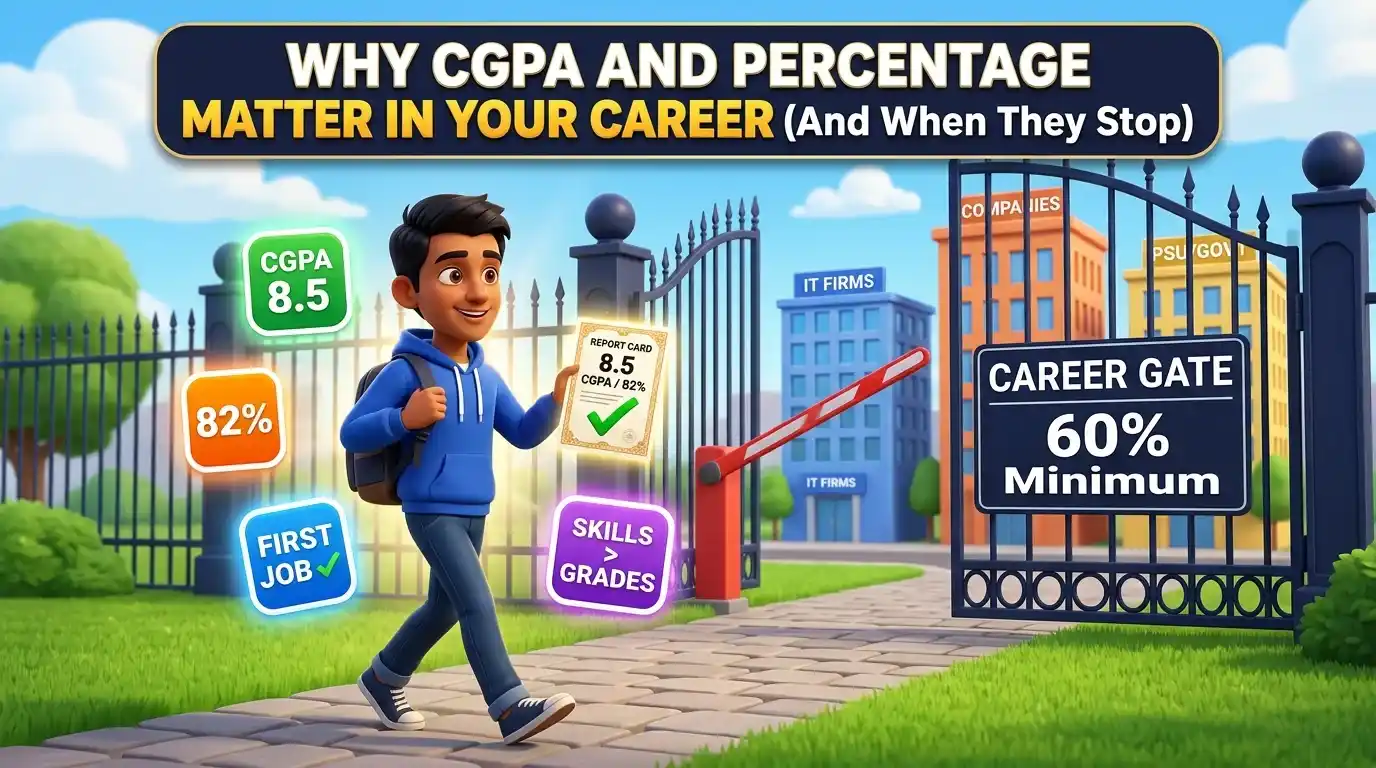
CGPA and percentage serve as the primary eligibility filters in your career during the first two to three years after graduation. Companies use them to shortlist candidates from large application pools before any human reviews your profile. Government recruitments set hard percentage cutoffs that automated systems enforce. Graduate programs and scholarships use CGPA as an admission criterion. After your first job, neither metric carries the same weight. Your work experience and skill record replace them. The window when CGPA and percentage control access to opportunities is real, finite, and worth taking seriously.
How Do CGPA and Percentage Filter Job Applications?
CGPA and percentage filter job applications by acting as a binary gate. Your score either clears the cutoff and moves your application forward, or it does not, and the system rejects it before any recruiter reads your name. TCS, Infosys, Wipro, HCL, and Cognizant all set 60% as the minimum aggregate for fresher hiring. Product companies and IIT campus placements commonly require 7.5 to 8.0 CGPA.
Amazon uses CGPA as an initial filter because large drives receive 10,000+ applications per cycle. The CGPA screen reduces that volume before any skill-based evaluation begins. A recruiter from Amazon stated directly in a published interview: “Once you’re in the interview room, your skills matter more than your marks.” The point is clear: CGPA gets you into the room. Skills determine what happens there.
The filtering threshold varies by employer type:
| Employer Type | Minimum CGPA (10-point) | Minimum Percentage |
|---|---|---|
| IT services (TCS, Infosys, Wipro, HCL) | 6.0-6.3 | 60% |
| IT product companies (mid-tier) | 7.0-7.5 | 66-71% |
| Top-tier tech (Google, Microsoft campus) | 8.0+ | 76%+ |
| Government / PSU (SSC, GATE-based) | No CGPA (percentage only) | 60% |
| MBA programs (top IIMs) | 6.0+ (UGC absolute) | 50-60% depending on category |
GPA to Percentage (gpatoopercentage.com) publishes verified conversion formulas for CBSE, VTU, Anna University, Mumbai University, SPPU, JNTUH, JNTUK, and GTU, so applicants can confirm their exact converted percentage before submitting to these employer portals. A CGPA of 6.32 on a 10-point scale converts to 60.04%, the minimum that clears the 60% gate. A CGPA of 6.3 converts to 59.9% and fails it.
Why Do Employers Use CGPA and Percentage as Hiring Criteria?
Employers use CGPA and percentage as hiring criteria because academic performance is the only verifiable, standardised signal available for candidates with no work experience. A fresh graduate has no revenue numbers, no managed projects, and no client outcomes to present. CGPA represents consistency: the ability to perform repeatedly across 8 semesters under varying conditions.
Three specific signals drive employer preference for academic scores:
Consistency over time
A student who maintains 7.5 CGPA across 8 semesters demonstrates sustained performance under pressure, exam variation, and subject difficulty changes. A single skill-test score or hackathon win does not carry the same temporal weight.
Discipline and reliability
Attendance requirements, assignment deadlines, and exam schedules mirror workplace accountability structures. A student who consistently meets academic standards is more likely to meet workplace ones. This is the “proxy for discipline” that HR departments reference in hiring guidelines.
Standardised comparison across institutions
Campus placement drives visit 20-30 colleges simultaneously. Comparing candidates by CGPA and percentage allows recruiters to rank applicants from VTU, Anna University, SPPU, and CBSE-affiliated colleges on a single axis, provided the correct university conversion formula is applied.
What Minimum CGPA Do Major Career Paths Require?
The minimum CGPA required for major career paths ranges from 6.0 for IT services roles to 8.0+ for product companies on-campus drives and competitive postgraduate programs. Government jobs and PSU recruitments set percentage-only cutoffs, with 60% as the most common threshold across SSC CGL, UPSC eligibility documentation, and PSU hiring through GATE.
Career path requirements by sector:
IT services and mass recruitment
TCS NQT, Infosys InfyTQ, Wipro NLTH, and HCL TechBee accept a minimum of 6.0 CGPA (60% equivalent). These companies run automated portal screening. Candidates below the cutoff receive an automated rejection. CGPA entries in percentage fields trigger the same outcome. Always convert and enter percentage.
Government and public sector
SSC CGL, SSC CHSL, and most state PSC exams require percentage at application. UPSC does not set a minimum percentage for Civil Services Preliminary but validates it at the Detailed Application Form stage. PSU recruitment through GATE (BHEL, NTPC, ONGC, GAIL, IOCL) requires 60% for engineering graduates. Use your university-specific conversion formula to produce a certifiable percentage before submitting.
Higher education and MBA
Top IIMs require 50% minimum for general category candidates under UGC CBCS absolute grading, equivalent to 5.27 CGPA on the 10-point scale. Foreign universities (US MS programs) typically accept the formula: Percentage = (CGPA / Maximum CGPA) x 100, so an 8.4/10 CGPA becomes 84%. Scholarship programs like the Prime Minister’s Research Fellowship (PMRF) require an 8.0 CGPA for direct entry.
Research and academic roles
PhD program eligibility across Indian universities requires 55% in postgraduation for general category, equivalent to 5.79 CGPA on the 10-point scale. UGC NET and CSIR NET require 55% in the qualifying degree. NET without a cutoff compliance disqualifies the application at document verification.
Does Percentage Matter More Than CGPA for Indian Government Jobs?
Percentage matters more than CGPA for Indian government jobs because government application forms, automated eligibility systems, and merit lists all process percentage as the primary academic metric. CGPA entered in a percentage field gets read as a number out of 100, which produces a value far below any eligibility cutoff and triggers immediate rejection.
Four government hiring contexts where the percentage is mandatory:
SSC CGL and CHSL
The online application form requires the aggregate percentage at graduation. The system cross-checks the entered percentage against the minimum eligibility declared in the notification. A CGPA of 7.0 entered as “7.0” reads as 7%, not 66.5%. The application fails instantly.
PSU recruitment through GATE
BHEL, NTPC, ONGC, GAIL, and IOCL all specify 60% minimum for engineering graduates in their annual recruitment notifications. GATE score determines merit rank. Percentage determines eligibility. Both are required simultaneously.
UPSC and state PSC service allocation
UPSC Civil Services does not set a percentage cutoff for Prelims, but service allocation at the final stage verifies academic credentials. State PSC Group A and Group B posts typically require 55-60% minimum depending on state and category.
UGC NET and teaching positions
Assistant Professor eligibility requires 55% in the postgraduate degree for general category candidates (50% for reserved categories). State TET, CTET, and public university faculty recruitment all process percentage, not CGPA.
Use the percentage to CGPA calculator on gpatoopercentage.com to verify reverse conversion when government notifications specify both formats or when eligibility requirements list percentage and your transcript shows CGPA.
When Does CGPA Stop Mattering in Your Career?
CGPA stops mattering in your career after your first job. Once you have 12 months of verified work experience, employers shift entirely to skill assessments, project outcomes, and professional references. No senior-level hiring process in the private sector asks for academic transcripts.
The career stage at which CGPA and percentage matter progressively narrows:
Year 0-1 (Final year and fresher)
CGPA is the primary eligibility filter. Campus placements, off-campus drives, and government exam eligibility all depend on it. This is the highest-stakes period for academic scores.
Year 1-3 (Early career)
Some employers request transcripts during background verification. Product companies hiring for specialist roles may review CGPA as one factor in a broader profile. Government applications at this stage still require percentage documentation.
Year 3+ (Mid career)
Private sector employers do not ask for academic transcripts. Performance reviews, project portfolios, and manager recommendations carry all the weight. CGPA is no longer referenced in any private sector hiring process.
Government sector exception
Government service entrance exams (UPSC, SSC, state PSC) remain percentage-dependent at every career stage because each exam represents a new entry-level selection, not a promotion. A 35-year-old sitting for UPSC CSE still needs to document graduation percentage at the Detailed Application Form stage.
How Does CGPA Affect Higher Education and Scholarship Access?
CGPA directly determines access to postgraduate programs, research fellowships, and merit-based scholarships. The Prime Minister’s Research Fellowship (PMRF) requires 8.0 CGPA for direct entry from a bachelor’s program. Most Indian university MTech programs require 6.0-6.5 CGPA. IIM MBA programs require 50% in graduation for general category applicants.
Scholarship thresholds tied directly to CGPA:
- Prime Minister’s Research Fellowship (PMRF): 8.0 CGPA direct entry from B.Tech
- CSIR Junior Research Fellowship (JRF): 55% in postgraduation (5.79 CGPA on 10-point scale)
- Commonwealth Scholarships: Minimum 60% equivalent in an undergraduate degree
- Fulbright-Nehru Master’s: No fixed cutoff but competitive applicants average 75%+ (7.9 CGPA)
- GATE-based MTech with stipend: 6.5/10 CGPA for qualifying examination eligibility
Foreign university applications convert your CGPA using the formula: Percentage = (CGPA / Maximum Grade Points) x 100. Use the CGPA calculator on gpatoopercentage.com to produce the exact converted figure each program requires before submitting applications on the Common App, UCAS, or university-specific portals.
Frequently Asked Questions
Does CGPA matter for IT jobs after graduation?
CGPA matters for IT fresher hiring at the application screening stage. TCS, Infosys, Wipro, and HCL all set a 60% minimum (6.32 CGPA on 10-point scale) for fresher applications. After your first year of employment, CGPA stops appearing in any private IT company’s hiring evaluation.
Is 6.5 CGPA enough to get a job?
A 6.5 CGPA converts to 61.75% on a 10-point scale using the CBSE x 9.5 formula. This clears the 60% threshold for IT services companies including TCS, Infosys, Wipro, and HCL. It falls below the 65-70% cutoffs used by product companies and top-tier tech firms for campus drives.
Do government jobs require percentage or CGPA?
Government job applications (SSC, UPSC, PSU, state PSC) require percentage. CGPA entered in a percentage field produces an incorrect value that fails automated eligibility checks. Convert your CGPA using your university’s official formula before submitting any government application.
What CGPA is required for IIM MBA admission?
IIMs require a minimum of 50% in graduation for general category candidates, equivalent to 5.27 CGPA on a 10-point absolute grading scale. Competitive admits typically carry 70%+ (7.37 CGPA). IIM Ahmedabad’s composite score formula weights graduation marks at 20% of the total shortlisting score.
Does a low CGPA end career prospects?
A CGPA below 6.0 (57% on 10-point scale) limits campus placement and government job eligibility. It does not permanently close career access. Off-campus applications, skill certifications, freelancing portfolios, and graduate entrance exams open alternative paths. After one year of verified work experience, CGPA stops being a filtering criterion in the private sector entirely.