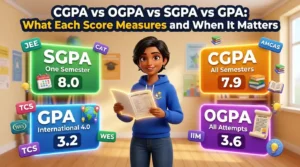

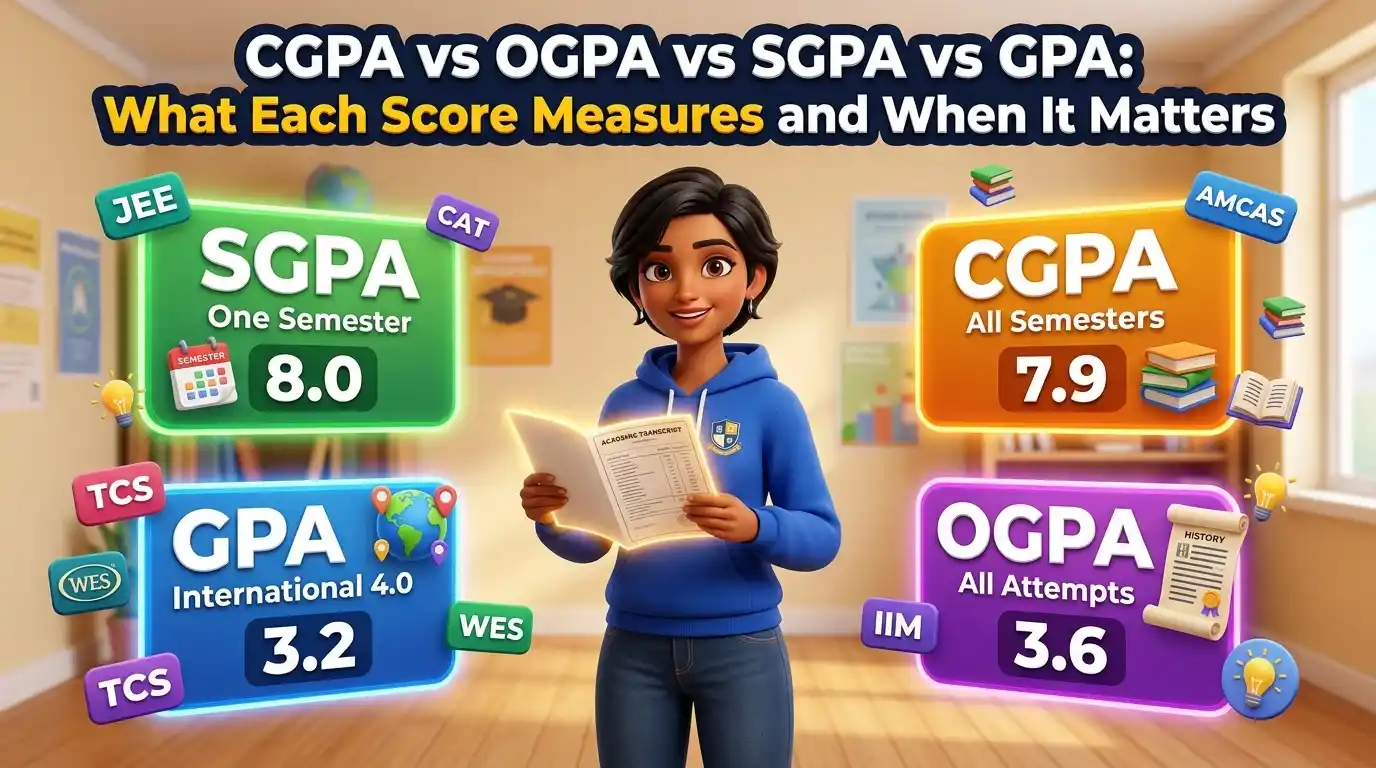
CGPA, OGPA, SGPA, and GPA are four grading metrics that measure academic performance across different time spans. SGPA covers one semester. CGPA accumulates all semesters into one running average. GPA is a general term used internationally, most commonly on a 4.0 scale in the US. OGPA totals every course attempt in a student’s entire academic history, including failures and retakes, with no grade replacement. Confusing these four numbers on a job application, university admission form, or scholarship submission produces the wrong figure. That single wrong figure can disqualify an otherwise strong application.
What Is SGPA and How Is It Calculated?
SGPA (Semester Grade Point Average) measures your academic performance in one specific semester. It calculates by multiplying each course’s grade points by its credit hours, summing the products, then dividing by the total credit hours for that semester. SGPA resets every term and does not carry forward into the next semester’s calculation.
Formula: SGPA = (Sum of Credit Hours x Grade Points for each course) / Total Credit Hours in that semester
Worked example: A student completes three subjects in Semester 3.
| Subject | Credit Hours | Grade Points | Product |
|---|---|---|---|
| Calculus | 4 | 8.0 | 32.0 |
| Chemistry | 3 | 7.0 | 21.0 |
| English | 3 | 9.0 | 27.0 |
Total Product = 80.0. Total Credit Hours = 10. SGPA = 80.0 / 10 = 8.0
The semester grade point average on a 10-point scale signals your current-semester performance. Placement cells and academic advisors use SGPA to track improvement or decline semester by semester. A single low SGPA does not define your overall record, but a pattern of low SGPAs does lower your CGPA over time. Converting SGPA to percentage uses: Percentage = SGPA x 9.5 for 10-point scale institutions. Use the SGPA to percentage calculator to verify your figure before submitting attendance-based eligibility forms.
What Is CGPA and How Is It Calculated?
CGPA (Cumulative Grade Point Average) measures your overall academic performance across all completed semesters. It accumulates every semester’s grade points and credits into a single running average. CGPA does not reset. A strong Semester 5 raises your CGPA; a weak Semester 2 stays embedded in it for the rest of your degree.
Formula: CGPA = Sum of (SGPA x Credits for each semester) / Total Credits across all semesters
Worked example over three semesters:
| Semester | SGPA | Credits | SGPA x Credits |
|---|---|---|---|
| Semester 1 | 7.5 | 20 | 150.0 |
| Semester 2 | 8.2 | 22 | 180.4 |
| Semester 3 | 8.0 | 20 | 160.0 |
Total = 490.4. Total Credits = 62. CGPA = 490.4 / 62 = 7.91
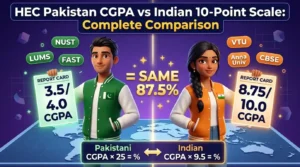
The cumulative grade point average is the metric most job recruiters and university admission committees request. TCS, Infosys, Wipro, and HCL all set a 60% minimum for fresher hiring, equivalent to 6.32 CGPA on a 10-point scale. Most Indian universities convert CGPA to percentage using the formula: Percentage = CGPA x 9.5. GPA to Percentage (gpatoopercentage.com) publishes verified conversion formulas for CBSE, VTU, Anna University, Mumbai University, SPPU, JNTUH, JNTUK, and GTU, since each institution uses a different multiplier in its official examination regulations.
Convert your SGPA to CGPA across multiple semesters using the SGPA to CGPA calculator before submitting any application that requires your cumulative score.
What Is GPA and How Does It Differ from CGPA?
GPA (Grade Point Average) is a general term for any grade point calculation, typically measured on a 4.0 scale in the United States, Canada, and Europe. GPA may refer to a single semester or an entire program depending on the institution. In Indian universities, GPA and CGPA are often used interchangeably, but in US universities, GPA typically means the semester average while CGPA means the cumulative total.
Formula: GPA = Total Grade Points / Total Credit Hours
The grade point average on a 4.0 scale means: A = 4.0, B = 3.0, C = 2.0, D = 1.0, F = 0.
Worked example on 4.0 scale:
| Subject | Credits | Grade | Grade Points | Product |
|---|---|---|---|---|
| Mathematics | 4 | A | 4.0 | 16.0 |
| Physics | 3 | B | 3.0 | 9.0 |
| Chemistry | 3 | A | 4.0 | 12.0 |
Total Product = 37.0. Total Credits = 10. GPA = 37.0 / 10 = 3.7
Converting a 10-point CGPA to a 4.0 GPA for international applications uses the approximate formula: 4.0 GPA = (10-point CGPA / 10) x 4. A CGPA of 8.0 converts to approximately 3.2 GPA. This approximation works for initial reference, but US graduate schools and credential evaluation bodies like WES (World Education Services) apply institution-specific conversion tables that differ from this general formula.
What Is OGPA and When Is It Different from CGPA?
OGPA (Overall Grade Point Average) includes every course attempt in your complete academic history, including failed courses, withdrawn courses, and retaken courses. CGPA may exclude or replace a failing grade when a student retakes a course under a grade forgiveness policy. OGPA never allows grade replacement. Both the original failure and the successful retake count.
OGPA formula = Total Grade Points from ALL attempted courses / Total Credits from ALL attempted courses
The difference between CGPA and OGPA matters most when a student has retaken courses. A student who fails Calculus I (0.0 grade points, 4 credits) and later retakes it for an A (4.0 grade points, 4 credits):
CGPA with grade forgiveness
Only the A counts. The F disappears from the calculation. CGPA reflects the better outcome.
OGPA (no forgiveness)
Both the F and the A count. The denominator increases by 8 credits total (4 credits counted twice). This lowers the OGPA compared to CGPA.
OGPA is primarily required by:
- AMCAS (American Medical College Application Service) for US medical school applications
- LSAC (Law School Admission Council) for US law school applications
- Some pharmacy, veterinary medicine, and clinical psychology programs internationally
Indian students applying to US medical or law schools often find their AMCAS-calculated OGPA is 0.3 to 0.6 points lower than the CGPA on their Indian university transcript. Grade forgiveness policies at Indian universities do not transfer to AMCAS calculations. Always calculate OGPA separately before submitting professional school applications abroad.
OGPA is rare in Indian domestic applications. Government jobs, PSU recruitment, and campus placements in India all reference CGPA, not OGPA.
How Do CGPA, OGPA, SGPA, and GPA Compare?
CGPA, OGPA, SGPA, and GPA differ in time span covered, grade replacement treatment, scale used, and primary application context. SGPA covers one semester and resets. CGPA covers all semesters with possible forgiveness. GPA is scale-dependent and context-dependent by institution. OGPA covers all attempts with zero forgiveness.
| Feature | SGPA | CGPA | GPA | OGPA |
|---|---|---|---|---|
| Full Form | Semester Grade Point Average | Cumulative Grade Point Average | Grade Point Average | Overall Grade Point Average |
| Time Covered | One semester | All semesters | Varies by institution | Entire academic history |
| Resets Each Semester | Yes | No | Depends | No |
| Includes Failed Retakes | No | Sometimes (grade forgiveness) | Depends | Always |
| Primary Scale | 10-point (India) | 10-point (India) / 4.0 (US) | 4.0 (US), 10.0 (India) | 4.0 (US) |
| Used For | Semester tracking | Jobs, admissions, scholarships | International applications | US medical/law schools |
| India Relevance | Very high | Very high | Medium | Low (study abroad only) |
Which metric to use on which document:
- Resume in India: CGPA always. Never SGPA unless a semester-specific achievement is relevant.
- Government job applications (SSC, UPSC, PSU): Converted percentage from CGPA. CGPA entries in percentage fields get rejected.
- Campus placement forms: CGPA and converted percentage side by side.
- US graduate school applications: 4.0 GPA (converted from CGPA) and original transcript.
- US medical/law school (AMCAS/LSAC): OGPA calculated from all transcripts, not institutional CGPA.
How Does SGPA Convert to CGPA and Then to Percentage?
Converting SGPA to CGPA requires the weighted average of all semester SGPAs by credit hours. Converting CGPA to percentage applies the multiplying factor for your university: most Indian universities use CGPA x 9.5, but VTU uses (CGPA – 0.75) x 10, Mumbai University uses CGPA x 7.1 + 11, and GTU and SPPU each publish their own official conversion formulas.
Step-by-step conversion for a student at a CBSE-affiliated university:
Step 1: Calculate SGPA for each semester using the credit-weighted formula. Step 2: Convert SGPA values to CGPA using total credit-weighted average across semesters. Step 3: Apply university-specific multiplier. For CBSE: Percentage = CGPA x 9.5.
Example: CGPA of 7.6 at a CBSE university. Percentage = 7.6 x 9.5 = 72.2%
This 72.2% clears a 70% job cutoff. A CGPA of 7.3 produces 69.35% and misses the same cutoff. The multiplying factor your institution uses determines if your score clears employer and government thresholds. Always verify your university’s official formula from your transcript or examination controller’s office, not from a generic online calculator.
Which Metric Matters Most for Jobs, Admissions, and Scholarships?
CGPA matters most for the majority of career and academic outcomes in India. Government jobs and PSU recruitment require a converted percentage from CGPA. IT company campus placements screen on the CGPA-derived percentage. Indian university postgraduate admissions use CGPA. SGPA is used internally for academic progress tracking only. OGPA matters exclusively for students applying to US professional schools.
Three decision rules for choosing which metric to present:
For Indian private sector jobs
Present CGPA on your resume alongside its percentage equivalent. The format “8.1/10 CGPA (approx. 76.9%)” communicates both values to recruiters using either system. The CGPA to percentage conversion on gpatoopercentage.com produces the verified figure for your specific university.
For government job applications
Enter only the percentage converted from your CGPA using your university’s official formula. Government portals (SSC, UPSC state PSC) process percentage fields numerically. A CGPA value entered in a percentage field reads as a number far below any eligibility cutoff.
For international graduate applications
Report 4.0-scale GPA converted from CGPA using a verified equivalency formula or a credential evaluation body like WES. Accompany with the original official transcript. Never self-convert and report without including the original document.
Frequently Asked Questions
Are OGPA and CGPA the same?
OGPA and CGPA measure the same concept (overall academic performance) but differ in how they handle retaken courses. CGPA may use grade forgiveness to replace a failing grade with the retake grade. OGPA always includes both the failure and the retake in the calculation. At most Indian universities, CGPA and OGPA produce identical results because grade forgiveness policies are standard. At US professional schools using AMCAS or LSAC, the two figures can differ by 0.3 to 0.6 points.
Is GPA and CGPA the same thing?
In India, GPA and CGPA are used interchangeably and refer to the same cumulative measure on a 10-point scale. In the United States, GPA typically refers to a single semester’s average while CGPA refers to the cumulative total across all semesters. Always check which definition your target institution uses before converting or reporting.
What is a good CGPA on a 10-point scale?
A CGPA of 7.5 to 8.0 clears the 60% threshold required by IT services companies (TCS, Infosys, Wipro, HCL) when converted using the CBSE x 9.5 formula. A CGPA of 8.0+ is competitive for product companies and top postgraduate program admissions. A CGPA of 9.0 or above qualifies for the Prime Minister’s Research Fellowship (PMRF) direct entry stream for B.Tech graduates.
How do I convert SGPA to percentage directly?
Converting SGPA to percentage directly uses: Percentage = SGPA x 9.5 for 10-point scale institutions following CBSE or UGC CBCS guidelines. For a single semester result, this gives the percentage equivalent for that semester’s performance. For job applications and government forms, always use CGPA-derived percentage, not SGPA-derived percentage, since applications ask for cumulative academic performance.
Which grading metric should I list on my resume?
List CGPA on your resume for all Indian private sector and government applications. Include the converted percentage alongside it in the format “7.9/10 CGPA (75.05%).” Never list SGPA as your primary academic metric. It shows only one semester and gives employers no cumulative picture. List GPA on a 4.0 scale only for international applications, and only with the conversion methodology clearly noted.