CGPA to Percentage Converter
CGPA converts to percentage by multiplying your cumulative grade point average by 9.5 on the standard 10-point grading scale used by CBSE and most Indian universities. The 4-point and 5-point CGPA scales use different multiplying factors (CGPA ÷ 4) × 100 and CGPA × 20 respectively.

More Calculators
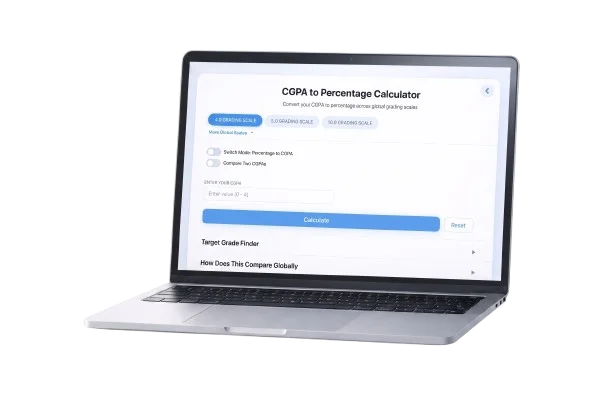
CGPA to Percentage Calculator
Convert your CGPA to percentage across global grading scales
Target Grade Finder
▶How Does This Compare Globally
▶Grade Calculator — Compute CGPA from Subject Grades
▶Calculation History
▶No calculations yet.
Effortless Grade Conversions at Your Fingertips
Select your grading scale, enter your CGPA, and get instant percentage equivalents with detailed grade breakdowns.
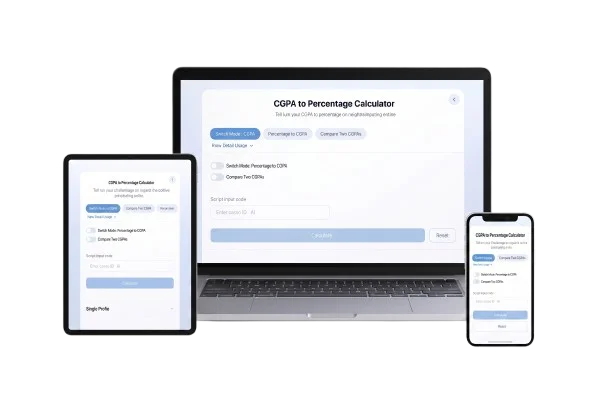
This calculator handles all three grading scales and eight major university-specific CGPA conversion formulas in one place. Enter your CGPA, select your scale, and the equivalent percentage appears instantly no formula memorisation needed.
How to Convert CGPA to Percentage — Formula, Steps, and Worked Example
CGPA converts to percentage by multiplying your grade point average by the scale-specific multiplying factor 9.5 for the standard 10-point scale. Take an 8.2 CGPA: 8.2 × 9.5 = 77.9%. That’s the number your employer, university, or scholarship committee sees on paper.
Here’s a 4-step process that works for any grading scale:
- Find your CGPA on your mark sheet or academic transcript
- Identify your grading scale 4-point, 5-point, or 10-point
- Apply the correct multiplying factor for your scale
- Cross-check the result against the conversion table below
The 9.5 multiplying factor comes from CBSE’s calibration when it introduced the 10-point grading scale in 2009. It’s the standard for most Indian universities but not all. Anna University uses (CGPA − 0.5) × 10. SPPU (Pune University) uses (CGPA − 0.75) × 10. Mumbai University Engineering calculates (CGPA × 7.1) + 11. Using the wrong formula means you submit the wrong percentage a problem that delays job applications and postgraduate admissions.
Employers and universities ask for percentage format because CBSE’s grading system post-dates millions of existing academic records. Pre-2009 institutions issued mark sheets in percentage only. Conversion bridges those two systems, and an official conversion certificate from your university carries legal weight in government job applications and foreign university admissions.
Why the Multiplying Factor Isn't Always 9.5
The CGPA multiplying factor changes based on the grading scale your university follows 9.5 for CBSE’s 10-point scale, 20 for the 5-point scale, and 25 for the 4-point scale. A student at SPPU multiplying by 9.5 gets a percentage that’s nearly 4 points higher than what SPPU’s official formula produces. That gap causes rejected job applications and admission forms that get flagged.
The multiplying factor also has university-specific versions. VTU and JNTUH multiply by 10. Anna University subtracts 0.5 before multiplying. Mumbai University Engineering adds 11 after multiplying by 7.1. Using the cgpa multiplying factor calculator on this page applies the correct factor for your institution automatically no manual cross-checking needed.
CGPA vs Percentage: What's the Actual Difference?
CGPA and percentage measure the same academic performance they express it on different scales. CGPA (Cumulative Grade Point Average) reports your performance as a number between 0 and 10 (or 0 and 4 depending on your institution). Percentage reports the same performance as a proportion of total marks, from 0% to 100%.
Think of it like temperature. Celsius and Fahrenheit both measure heat the reading changes, the underlying temperature doesn’t. Your 8.0 CGPA and 76% percentage describe the same academic record, formatted two different ways for two different audiences.
What is CGPA and How Does It Work?
CGPA (Cumulative Grade Point Average) calculates the average of grade points earned across all subjects in all completed semesters. CBSE introduced the CGPA system in 2009 for Class 10 students to replace the single-mark ranking model that created intense competition over individual marks.
Each subject earns a grade point between 1 and 10. Those grade points are averaged weighted by credit hours at most universities to produce the CGPA. A student scoring A1 in all subjects holds a 10.0 CGPA. The grade band system groups students rather than separating them by single marks, which reduces rank-chasing pressure while still tracking academic progress.
CGPA appears on mark sheets from CBSE, most Indian universities, and HEC Pakistan (on a 4.0 scale). It’s the primary academic performance metric for students graduating after 2009.
What is Percentage and When Does It Apply?
Percentage measures obtained marks as a fraction of maximum possible marks, multiplied by 100. A student scoring 760 out of 1,000 total marks holds a 76% score. Percentage has existed in Indian education since before independence every institution before 2009 issued results in this format.
Percentage remains the required format for government job applications under UPSC and state PSC rules, many private sector recruitment portals, foreign university admissions outside the US and UK, and scholarship eligibility criteria that set minimum percentage thresholds.
Students with CGPA on their mark sheet need to convert to percentage specifically because the systems these bodies use were built before CGPA existed. The conversion gives those legacy systems a number they can process.
CGPA vs Percentage: Side-by-Side Comparison
| Attribute | CGPA | Percentage | GPA (4.0 Scale) |
|---|---|---|---|
| Scale | 0–10 (India) | 0–100% | 0–4.0 (US/Pakistan) |
| Introduced by | CBSE 2009 | Legacy system | US universities |
| Used for | Semester grading | Job apps, admissions | HEC Pakistan |
| Grading method | Grade point bands | Exact marks ratio | Grade point bands |
| Convert to % | × 9.5 (CBSE) | Already % | ÷ 4 × 100 |
| Who requires it | Universities | Employers, govt. | International bodies |
Which One is Better — CGPA or Percentage?
Neither CGPA nor percentage is inherently better each format serves a different audience. CGPA reduces rank pressure and enables consistent grading across subjects with different difficulty levels. Percentage provides a universal number that legacy hiring and admissions systems can compare without conversion. The format your institution uses determines your mark sheet; the audience you’re submitting to determines which format you need.
CGPA works better inside academic institutions tracking semester-wise performance. Percentage works better when submitting records to systems built before 2009. That’s why the CGPA to percentage conversion exists it’s a translation service, not an upgrade or downgrade of your academic record.
The 4-point GPA scale used by HEC Pakistan and US universities adds a third dimension. A 3.2 GPA equals 80%. An Indian student with 8.0 CGPA on the 10-point scale lands at 76% using the CBSE formula. Different scales, different starting numbers percentage makes all three comparable on one axis. Understanding your grading scale determines which conversion formula applies, and three distinct scale types cover South Asian and international academic systems.
CGPA vs SGPA — Which One Appears on Your Mark Sheet?
CGPA and SGPA both measure grade point averages CGPA covers your entire academic career, while SGPA covers a single semester. Your mark sheet shows both: SGPA for each semester you completed, and CGPA as the running cumulative average across all semesters combined.
Think of SGPA as a chapter score and CGPA as the book score. A student scoring 8.5 SGPA in semester 3 and 7.5 SGPA in semester 4 doesn’t simply average those two the university weights each semester by its total credit hours to produce the CGPA. That’s why a strong final-year performance improves your CGPA, but can’t erase a weak first year.
How SGPA Converts to Percentage
SGPA converts to percentage using the same multiplying factor as CGPA for most universities. On the standard 10-point scale, multiply SGPA by 9.5. An SGPA of 8.0 equals 76%. Some universities apply a slightly different formula VTU and JNTUH multiply SGPA by 10 directly, producing 80% from the same 8.0 SGPA. Use the SGPA to percentage calculator to get the exact conversion for your semester performance without manual calculation.
CGPA vs SGPA: Key Differences
| Attribute | CGPA | SGPA |
|---|---|---|
| Full form | Cumulative Grade Point Average | Semester Grade Point Average |
| Covers | All completed semesters | One semester only |
| Appears on | Final mark sheet, degree certificate | Semester-wise mark sheet |
| Used for | Job applications, admissions, overall rank | Internal academic tracking |
| Converts to % | CGPA × 9.5 (CBSE standard) | SGPA × 9.5 (same formula) |
| Changes after each semester | Yes recalculated cumulatively | Resets each semester |
CGPA matters when you graduate and submit your academic record externally. SGPA matters each semester when your university checks promotion eligibility most institutions require a minimum SGPA (typically 5.0 or 6.0 out of 10) to advance to the next year. A student converting their CGPA to percentage for a job application needs the CGPA figure from their final mark sheet, not any individual semester’s SGPA.
What Your Percentage Means
First Class starts at 60%, Second Class at 50%, Third Class at 40%, and Distinction at 75% and above. These bands apply across most Indian universities, though exact thresholds vary some institutions set First Class at 55% or Distinction at 70%.
| Classification | Percentage Band | Equivalent CGPA (10-pt) |
|---|---|---|
| Distinction | 75% and above | 7.89+ |
| First Class | 60% – 74.9% | 6.32 – 7.88 |
| Second Class | 50% – 59.9% | 5.26 – 6.31 |
| Third Class | 40% – 49.9% | 4.21 – 5.25 |
| Pass | 35% – 39.9% | 3.68 – 4.20 |
How to Convert a Grade or Grade Point to Percentage
A grade converts to percentage by first mapping the letter grade to its grade point equivalent, then multiplying by the scale factor. An A1 grade maps to 10 grade points 10 × 9.5 = 95%. A B2 maps to 8 grade points 8 × 9.5 = 76%.
Grade points like 6.7, 7.67, or 8.7 on a 10-point scale follow the same ×9.5 formula regardless of whether the mark sheet labels them “grade” or “grade point.” A 5.6 grade in percentage terms equals 53.2%. A 6.2 grade equals 58.9%. The grade classification table above shows where each converted percentage lands in the First, Second, or Third Class band.
CGPA to Percentage Conversion Tables
The multiplying factor changes based on the grading scale your university uses 25 for the 4-point scale, 20 for the 5-point scale, and 9.5 for the standard Indian 10-point scale. Pick the table matching your institution’s grading system.
4-Point Scale CGPA/GPA to Percentage Table (0.1–4.0)
Formula: Percentage = (CGPA ÷ 4) × 100. Used by HEC Pakistan, US universities, and international programs.
| CGPA | % | CGPA | % | CGPA | % | CGPA | % |
|---|---|---|---|---|---|---|---|
| 0.1 | 2.5 | 1.1 | 27.5 | 2.1 | 52.5 | 3.1 | 77.5 |
| 0.2 | 5.0 | 1.2 | 30.0 | 2.2 | 55.0 | 3.2 | 80.0 |
| 0.3 | 7.5 | 1.3 | 32.5 | 2.3 | 57.5 | 3.3 | 82.5 |
| 0.4 | 10.0 | 1.4 | 35.0 | 2.4 | 60.0 | 3.4 | 85.0 |
| 0.5 | 12.5 | 1.5 | 37.5 | 2.5 | 62.5 | 3.5 | 87.5 |
| 0.6 | 15.0 | 1.6 | 40.0 | 2.6 | 65.0 | 3.6 | 90.0 |
| 0.7 | 17.5 | 1.7 | 42.5 | 2.7 | 67.5 | 3.7 | 92.5 |
| 0.8 | 20.0 | 1.8 | 45.0 | 2.8 | 70.0 | 3.8 | 95.0 |
| 0.9 | 22.5 | 1.9 | 47.5 | 2.9 | 72.5 | 3.9 | 97.5 |
| 1.0 | 25.0 | 2.0 | 50.0 | 3.0 | 75.0 | 4.0 | 100.0 |
5-Point Scale CGPA to Percentage Table (0.1–5.0)
Formula: Percentage = CGPA × 20. Used by select Indian state universities and some international institutions.
| CGPA | % | CGPA | % | CGPA | % | CGPA | % | CGPA | % |
|---|---|---|---|---|---|---|---|---|---|
| 0.1 | 2.0 | 1.1 | 22.0 | 2.1 | 42.0 | 3.1 | 62.0 | 4.1 | 82.0 |
| 0.2 | 4.0 | 1.2 | 24.0 | 2.2 | 44.0 | 3.2 | 64.0 | 4.2 | 84.0 |
| 0.3 | 6.0 | 1.3 | 26.0 | 2.3 | 46.0 | 3.3 | 66.0 | 4.3 | 86.0 |
| 0.4 | 8.0 | 1.4 | 28.0 | 2.4 | 48.0 | 3.4 | 68.0 | 4.4 | 88.0 |
| 0.5 | 10.0 | 1.5 | 30.0 | 2.5 | 50.0 | 3.5 | 70.0 | 4.5 | 90.0 |
| 0.6 | 12.0 | 1.6 | 32.0 | 2.6 | 52.0 | 3.6 | 72.0 | 4.6 | 92.0 |
| 0.7 | 14.0 | 1.7 | 34.0 | 2.7 | 54.0 | 3.7 | 74.0 | 4.7 | 94.0 |
| 0.8 | 16.0 | 1.8 | 36.0 | 2.8 | 56.0 | 3.8 | 76.0 | 4.8 | 96.0 |
| 0.9 | 18.0 | 1.9 | 38.0 | 2.9 | 58.0 | 3.9 | 78.0 | 4.9 | 98.0 |
| 1.0 | 20.0 | 2.0 | 40.0 | 3.0 | 60.0 | 4.0 | 80.0 | 5.0 | 100.0 |
10-Point Scale CGPA to Percentage Table (1.0–10.0)
Formula: Percentage = CGPA × 9.5. Used by CBSE, SPPU, VTU, JNTUH, JNTUK, GTU, Anna University, and Delhi University.
| CGPA | % | CGPA | % | CGPA | % | CGPA | % |
|---|---|---|---|---|---|---|---|
| 1.0 | 9.50 | 3.6 | 34.20 | 6.1 | 57.95 | 8.6 | 81.70 |
| 1.1 | 10.45 | 3.7 | 35.15 | 6.2 | 58.90 | 8.7 | 82.65 |
| 1.2 | 11.40 | 3.8 | 36.10 | 6.3 | 59.85 | 8.8 | 83.60 |
| 1.3 | 12.35 | 3.9 | 37.05 | 6.4 | 60.80 | 8.9 | 84.55 |
| 1.4 | 13.30 | 4.0 | 38.00 | 6.5 | 61.75 | 9.0 | 85.50 |
| 1.5 | 14.25 | 4.1 | 38.95 | 6.6 | 62.70 | 9.1 | 86.45 |
| 1.6 | 15.20 | 4.2 | 39.90 | 6.7 | 63.65 | 9.2 | 87.40 |
| 1.7 | 16.15 | 4.3 | 40.85 | 6.8 | 64.60 | 9.3 | 88.35 |
| 1.8 | 17.10 | 4.4 | 41.80 | 6.9 | 65.55 | 9.4 | 89.30 |
| 1.9 | 18.05 | 4.5 | 42.75 | 7.0 | 66.50 | 9.5 | 90.25 |
| 2.0 | 19.00 | 4.6 | 43.70 | 7.1 | 67.45 | 9.6 | 91.20 |
| 2.1 | 19.95 | 4.7 | 44.65 | 7.2 | 68.40 | 9.7 | 92.15 |
| 2.2 | 20.90 | 4.8 | 45.60 | 7.3 | 69.35 | 9.8 | 93.10 |
| 2.3 | 21.85 | 4.9 | 46.55 | 7.4 | 70.30 | 9.9 | 94.05 |
| 2.4 | 22.80 | 5.0 | 47.50 | 7.5 | 71.25 | 10.0 | 95%–100% |
| 2.5 | 23.75 | 5.1 | 48.45 | 7.6 | 72.20 | ||
| 2.6 | 24.70 | 5.2 | 49.40 | 7.7 | 73.15 | ||
| 2.7 | 25.65 | 5.3 | 50.35 | 7.8 | 74.10 | ||
| 2.8 | 26.60 | 5.4 | 51.30 | 7.9 | 75.05 | ||
| 2.9 | 27.55 | 5.5 | 52.25 | 8.0 | 76.00 | ||
| 3.0 | 28.50 | 5.6 | 53.20 | 8.1 | 76.95 | ||
| 3.1 | 29.45 | 5.7 | 54.15 | 8.5 | 80.75 | ||
| 3.2 | 30.40 | 5.8 | 55.10 | 8.2 | 77.90 | ||
| 3.3 | 31.35 | 5.9 | 56.05 | 8.3 | 78.85 | ||
| 3.4 | 32.30 | 6.0 | 57.00 | 8.4 | 79.80 | ||
| 3.5 | 33.25 | 9.0 | 85.50 |
CBSE treats 10.0 CGPA as a 95%–100% band, not a fixed single value.
University-Specific CGPA Formulas — Why the Multiplier Changes
Each university sets its own CGPA to percentage formula because India has no single national conversion standard. CBSE uses 9.5, Anna University uses (CGPA − 0.5) × 10, and Mumbai University Engineering uses (CGPA × 7.1) + 11. Apply the wrong formula and your submitted percentage differs from what your institution officially certifies.
| University | Formula | Example: CGPA 8.0 | Scale |
|---|---|---|---|
| CBSE / General | CGPA × 9.5 | 76% | 10-point |
| SPPU (Pune) | (CGPA − 0.75) × 10 | 72.5% | 10-point |
| Mumbai Univ. (Engg.) | (CGPA × 7.1) + 11 | 67.8% | 10-point |
| Anna University | (CGPA − 0.5) × 10 | 75% | 10-point |
| VTU | CGPA × 10 | 80% | 10-point |
| GTU | (CGPA − 0.5) × 10 | 75% | 10-point |
| JNTUH / JNTUK | CGPA × 10 | 80% | 10-point |
| HEC Pakistan | (CGPA ÷ 4) × 100 | — | 4-point |
For government job applications and foreign university admissions, your institution issues an official conversion certificate that states your equivalent percentage using their specific formula. The CBSE formula (× 9.5) never substitutes for an institution’s own certified conversion. Use the university-specific CGPA to percentage calculators on this site to get the exact figure your institution would produce not the general estimate.
SPU (Shoolini University) and Asian International University both use institution-specific formulas that differ from the CBSE 9.5 standard. The (CGPA – 2.00) × 10 + 50 formula is used by select Indian state universities it produces significantly different results than multiplying by 9.5.
For a CGPA of 7.0: the standard formula gives 66.5%, while (7.0 – 2.00) × 10 + 50 gives 100% which immediately shows this formula targets a different scale range, typically 2.0 to 5.0. Always confirm which formula your institution officially certifies before submitting a converted percentage on any application.
Frequently Asked Questions
What is 7.5 CGPA in percentage?
7.5 CGPA equals 71.25% on the standard CBSE 10-point grading scale, calculated as 7.5 × 9.5. Under the SPPU (Pune University) formula, the same 7.5 CGPA equals 67.5% (7.5 − 0.75) × 10. The result differs by nearly 4 percentage points depending on which university’s conversion formula applies.
Always confirm your institution’s formula before submitting a converted percentage on a job application or admission form. The CBSE standard works for most Indian universities, but SPPU, Mumbai University, and Anna University each publish their own conversion method.
What is 7.6 CGPA in percentage?
7.6 CGPA equals 72.2% on the CBSE 10-point scale (7.6 × 9.5). This value appears directly in the conversion table above. On a 4-point scale, 7.6 doesn’t exist; the maximum on that scale is 4.0.
What is 6.5 CGPA in percentage?
6.5 CGPA converts to 61.75% using the standard multiplying factor of 9.5. This falls in the Second Class category under most Indian university percentage classification systems, which typically define First Class as 60%–74.9% and Distinction as 75% and above. Check your university’s grading bands classification thresholds vary.
What is 70% in CGPA?
70% equals a CGPA of 7.37 on the 10-point scale calculated as 70 ÷ 9.5. For reverse conversion across all three scales, use the percentage to CGPA calculator on this site. It handles 4-point, 5-point, and 10-point scales and outputs the equivalent CGPA instantly.
Is CGPA × 9.5 always the correct formula?
No. CGPA × 9.5 applies only to CBSE and universities that follow the CBSE 10-point grading scale. Anna University uses (CGPA − 0.5) × 10. SPPU uses (CGPA − 0.75) × 10. HEC Pakistan converts from a 4-point scale using (CGPA ÷ 4) × 100 entirely. Each institution’s official conversion formula overrides the CBSE general standard always verify with your university’s published method.
How do I convert CGPA out of 4 to percentage?
Divide your CGPA by 4 and multiply by 100. A 3.2 CGPA on the 4-point scale equals 80%. This formula applies to HEC Pakistan and US university grading systems. A 3.0 GPA equals 75%, a 3.5 GPA equals 87.5%, and a perfect 4.0 GPA equals 100%.
What is 7.37 CGPA in Percentage?
7.37 CGPA equals 70.015% on the CBSE 10-point scale (7.37 × 9.5). Under SPPU’s formula (CGPA – 0.75) × 10, the same 7.37 CGPA gives 66.2%. The number matters because 70% is the First Class threshold at most Indian universities 7.37 sits exactly on that line.
What is 7.5 CGPA in Percentage?
7.5 CGPA equals 71.25% on the standard 10-point scale. Under SPPU’s formula, 7.5 CGPA gives 67.5% nearly 4 points lower. Confirm your university’s formula before submitting this figure to employers or postgraduate admissions.
What is 7.93 CGPA in Percentage?
7.93 CGPA equals 75.335% on the 10-point scale (7.93 × 9.5). This value crosses the Distinction threshold of 75% at most institutions a detail that affects scholarship eligibility and merit-based admissions.
What is 9.6 or 9.7 CGPA in Percentage?
9.6 CGPA equals 91.20% and 9.7 CGPA equals 92.15% using the standard ×9.5 formula. Under CBSE’s grading system, both values fall within the 95%-100% band on the official mark sheet CBSE doesn’t assign a fixed single percentage to scores above 9.5.
What is 3.2 GPA or CGPA Out of 4 in Percentage?
3.2 GPA or CGPA out of 4 equals 80% using the formula (3.2 ÷ 4) × 100. This applies to HEC Pakistan and US university grading systems. On the Indian 10-point scale, 3.2 doesn’t exist as a valid CGPA the maximum is 10.0.
What is 2.9 CGPA Out of 4 in Percentage?
2.9 CGPA out of 4 equals 72.5% (2.9 ÷ 4 × 100). For Pakistani students converting under HEC requirements, 2.9 out of 4 places in the Second Division band at most institutions.
What is 67.8% or 76% in CGPA?
67.8% converts to 7.137 CGPA on the 10-point scale (67.8 ÷ 9.5). 76% converts to 8.0 CGPA exactly the most searched reverse conversion because 76% sits at the clean threshold most students remember from mark sheets. On the 4-point scale, 76% equals 3.04 GPA (76 ÷ 25).
More Academic Calculators Your Complete Grade Conversion Toolkit
CGPA to percentage is one conversion students tracking full academic performance need SGPA, marks, and reverse conversion tools across multiple semesters. This site covers the complete grade conversion toolkit in one place.
Convert your SGPA to percentage for semester-wise performance. Use the percentage to CGPA calculator for reverse conversion. Track subject-level scores with the marks percentage calculator.
For your university’s exact formula, select from the dedicated calculators below each one uses the institution’s officially published conversion method, not the generic CBSE estimate:
Your Permanent CGPA Conversion Reference
Bookmark this page — for every semester, every application, and every university that asks for percentage format.
Bookmark this page
It's your permanent CGPA conversion reference for every semester, every application, and every university that asks for percentage format.
University Calculators
CGPA-to-percentage calculators tailored to specific universities — including SPPU, VTU, JNTU, and more.
Grading Scales
Browse and compare grading systems from universities worldwide — 10-point, 4-point, letter grades, and more.
Glossary
Plain-English definitions for CGPA, SGPA, GPA, credit hours, and every other academic term you'll encounter.
All Calculators
The full suite — SGPA to percentage, CGPA calculator, marks to percentage, attendance, and more in one place.
Why Students Trust Us
Accurate Formulas
We use precise, university-based conversion formulas to ensure correct percentage results every time.

Instant Results
Enter your CGPA and get your percentage in seconds without delays.

Works for All Grading Scales
Supports 4.0, 5.0, and 10.0 grading systems used worldwide.
Your Complete Grade Conversion Tool
Take control of your grades with one powerful, easy-to-use tool. Instantly convert CGPA to Percentage, turn grades into percentages, and calculate your overall score just enter your marks and get fast, accurate results. Track your progress clearly, stay organized across all subjects, and plan your studies with confidence.
User-Friendly
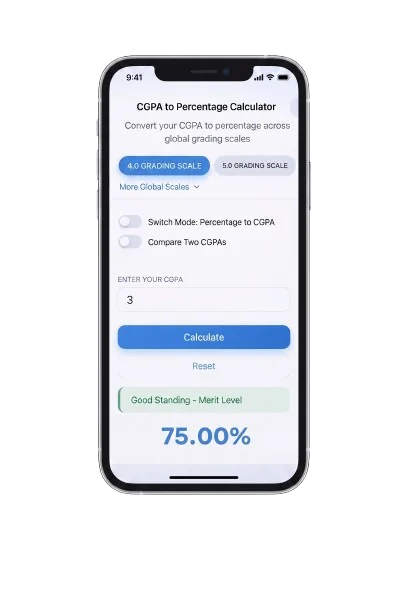
The tool features a simple and clean interface where users only need to enter their CGPA to get instant results. No complex steps or technical knowledge are required, making it easy for everyone to use.
Seamless and Efficient
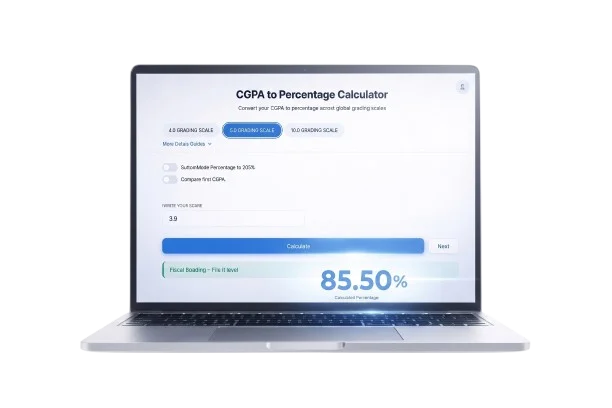
The calculator works smoothly online and delivers fast, accurate results within seconds. Its efficient performance ensures a hassle-free experience without delays or errors.
Accessibility & Versatility
Our CGPA to Percentage Calculator is accessible anytime on any device, allowing students to convert grades quickly and easily. It supports accurate conversions for different academic systems.