CGPA Grading Scales
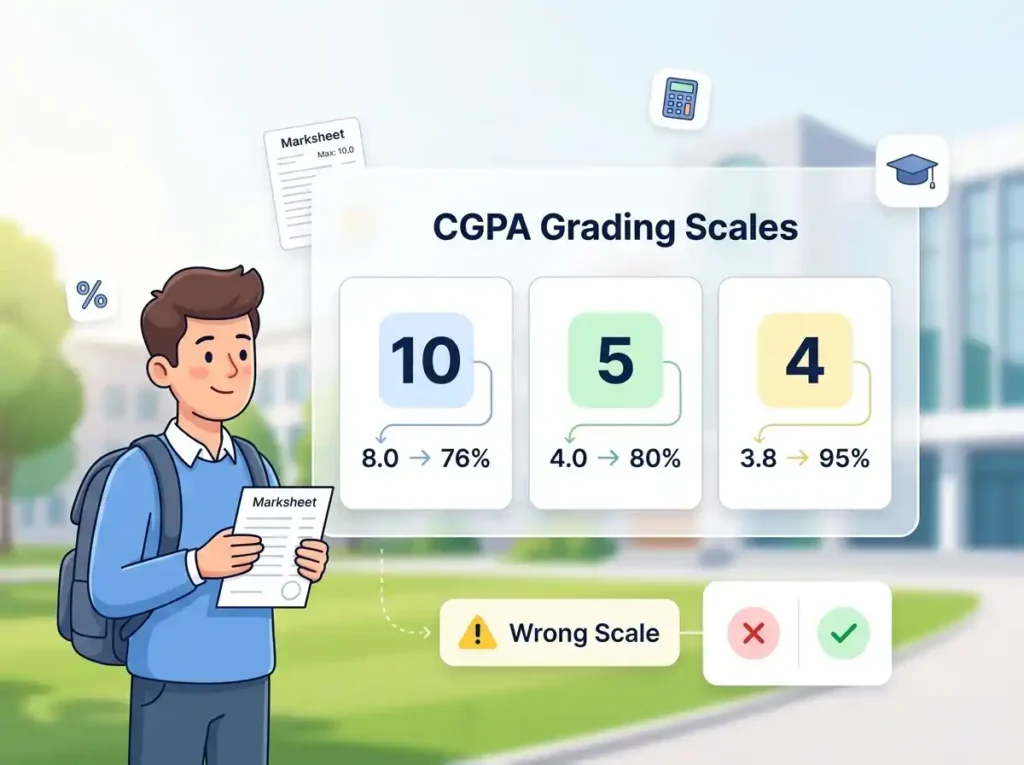
A grading scale is the numerical range on which your CGPA is measured. universities use three different scales 10-point, 5-point, and 4-point.
Which Scale Does Your University Use?
The scale your university uses determines which conversion formula applies to you. Using the wrong scale gives a percentage that won’t match your official marksheet.
Your grading scale is printed on your marksheet. The maximum CGPA achievable on your grade sheet tells you the scale directly if the highest possible CGPA is 10.0, you’re on a 10-point scale; if it’s 4.0, you’re on a 4-point scale.
Check your grade boundary table.
If your highest grade (O or A+) corresponds to 10 grade points, you’re on a 10-point scale. If it corresponds to 4.0, you’re on a 4-point scale.
Check your marksheet maximum.
The ceiling CGPA is always printed on your official grade sheet. That single number identifies your scale without any calculation.
Check UGC affiliation.
The UGC recommended the 10-point scale as the national standard in 2009, and most central and state universities follow it. Private deemed universities sometimes use a 4-point scale for international alignment. Older institutions and diploma programs may still operate on a 5-point scale. Understanding the grading scale your institution follows and the credit system behind it clarifies which conversion path applies before you touch any formula.
10-Point, 5-Point, 4-Point — What Each Scale Covers
| Scale | CGPA Range | Common Users | Base Formula |
|---|---|---|---|
| 10-Point | 0 – 10 | Most Indian universities, UGC standard | CGPA × 9.5 |
| 5-Point | 0 – 5 | Legacy institutions, some diploma programs | CGPA × 20 |
| 4-Point | 0 – 4 | Private universities, international alignment | CGPA × 25 |
The base formula column tells you immediately why different scales need different calculators. A 4-point CGPA multiplied by 9.5 gives a percentage that means nothing — the formula doesn’t fit the scale.
Why Your Scale Determines Your Formula
The conversion formula maps your CGPA onto a 0-100 percentage scale. The multiplier comes directly from the scale maximum.
| Scale Maximum | Calculation | Base Multiplier |
|---|---|---|
| 10-point | 100 ÷ 10 | ×10 (adjusted to ×9.5 by UGC) |
| 5-point | 100 ÷ 5 | ×20 |
| 4-point | 100 ÷ 4 | ×25 |
The math is straightforward — but universities sometimes adjust the base multiplier based on internal grade calibration. Mumbai University, for example, uses CGPA × 7.1 + 11 instead of the standard ×9.5, because its internal grade boundaries don’t map cleanly to the UGC default. When a university publishes its own official formula, that formula overrides the scale default entirely. If your university has issued its own conversion method, use the university-specific calculator rather than the generic scale formula.
Why Confusing a 4-Point and 10-Point Scale Destroys Your Application
A 3.8 CGPA means completely different things depending on which scale produced it.
Students who apply the wrong formula either drastically underreport or overreport their academic performance on job applications and admission forms. A student on a 4-point scale who uses the ×9.5 formula reports 36.1% on a form where 75% is the cutoff. They fail a filter they should have cleared comfortably. The reverse is equally damaging — a student on a 10-point scale who treats their CGPA as a 4-point score inflates their percentage and creates a verification mismatch the moment an employer checks their marksheet.
Identifying your scale before converting isn’t a formality. It’s the only way the percentage you report matches the one your university would confirm.
FAQ
Q: How do I know which scale my university uses?
Check the maximum CGPA on your marksheet or grade sheet. That number is your scale maximum — 10.0 means 10-point, 4.0 means 4-point, 5.0 means 5-point. No calculation needed. The answer is already on your official document.
Q: Most of my friends have CGPA out of 10 but mine looks different — why?
Your institution likely uses a 4-point or 5-point scale. Some private and deemed universities deliberately align with international grading systems that use a 4-point maximum. This doesn’t mean your grades are worse — it means the scale is different and requires a different formula for conversion.
Q: Can I convert a 4-point CGPA the same way as a 10-point CGPA?
No. The formulas are completely different. A 4-point CGPA uses CGPA × 25. A 10-point CGPA uses CGPA × 9.5 or × 10. Applying the 10-point formula to a 4-point score gives a percentage that’s less than half your actual result. Always confirm your scale before converting.
Q: My university is on the 10-point scale but the standard formula gives a different answer than my official documents — why?
Your university has its own official multiplier that overrides the UGC default. This happens at Mumbai University, GTU, SPPU, and several others. Use the university-specific calculator rather than the generic ×9.5 formula — the generic formula won’t produce a percentage your marksheet can verify.
Q: Is the 10-point scale better than the 4-point scale?
Neither scale is better. They’re different systems built for different contexts. The 10-point scale is the Indian standard recommended by UGC. The 4-point scale aligns with international norms used in the US and many other countries. What matters for applications is the percentage equivalent, not the scale itself. Use the homepage calculator once you’ve confirmed your scale to get the right figure.
CGPA to Percentage by Grading Scale
Pick your grading scale and get an accurate percentage conversion instantly.
10-Point Grading Scale
Most common in Indian universities
Convert CGPA on a 10-point scale to percentage — used by VTU, JNTUK, JNTUH, Anna University, and many more.
5-Point Grading Scale
Used by select state universities
Convert CGPA on a 5-point scale to an accurate percentage using the correct multiplier for your institution.
4-Point Grading Scale
Standard US & international GPA
Convert GPA on a 4-point scale to percentage — widely used by US universities and international institutions.
CBSE Grading Scale
Pan-India school board
Convert CBSE CGPA to percentage using the official ×9.5 formula — applies to Class 10 and Class 12 results.
Can't Find Your Grading Scale?
Use our standard CGPA to Percentage Calculator with multiple grading scales (4.0, 5.0, 10.0) for any university worldwide.