

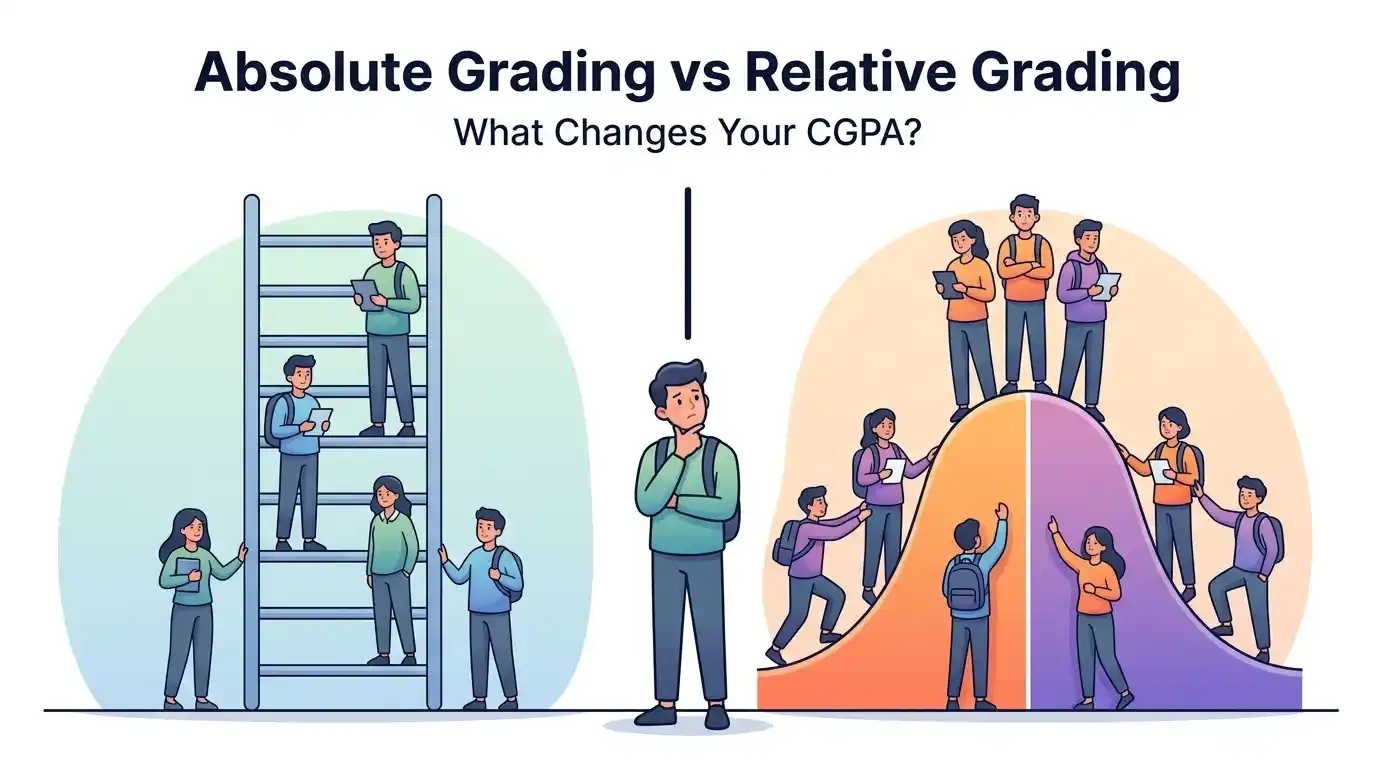
Absolute grading assigns grades against fixed mark ranges set before any exam takes place. Relative grading assigns grades by comparing your score against your classmates, using class mean and standard deviation to set grade boundaries after results arrive. The system your university uses directly determines what your CGPA number means, how employers read it, and how accurately a converted percentage reflects your academic performance. A CGPA of 8.5 from an IIT running relative grading cannot be directly compared to a CGPA of 8.5 from Delhi University running absolute grading. The same number represents different things.
GPA to Percentage (gpatoopercentage.com) covers CGPA conversion formulas for 8 major Indian universities. Understanding which grading system produced your CGPA helps you present the converted figure accurately on job applications and graduate school forms.
What Is Absolute Grading?
Absolute grading assigns grades based on fixed mark ranges decided before the examination. A student scoring 85-100 earns an O (Outstanding), 75-84 earns A+, 65-74 earns A, and so on, regardless of how the rest of the class performs. The UGC Choice Based Credit System (CBCS), introduced in 2015 and revised in 2019, recommends absolute grading as the standard for all Indian universities.
The UGC CBCS absolute grading scale maps marks to grade points as follows:
| Grade | Grade Point | Marks Range |
|---|---|---|
| O (Outstanding) | 10 | 85-100 |
| A+ (Excellent) | 9 | 75-84 |
| A (Very Good) | 8 | 65-74 |
| B+ (Good) | 7 | 55-64 |
| B (Above Average) | 6 | 50-54 |
| C (Average) | 5 | 45-49 |
| P (Pass) | 4 | 40-44 |
| F (Fail) | 0 | Below 40 |
University of Delhi adopted the UGC CBCS absolute scale for all affiliated colleges after 2015. Anna University uses its own absolute scale where O grade starts at 91 rather than 85. Most state-affiliated universities follow the UGC framework under the National Education Policy 2020 implementation pressure.
SGPA (Semester Grade Point Average) is calculated as the credit-weighted mean of grade points in one semester. CGPA then accumulates SGPA values across all semesters of the program.
What Is Relative Grading?
Relative grading assigns grades after results arrive, using class mean (μ) and standard deviation (σ) to set grade boundaries for that specific cohort. A student scoring 85 in a class where the average is 80 may receive a B. The same 85 in a class where the average is 60 earns an AA. The mark stays the same. The grade changes.
The standard bell-curve model used at IIT Madras, IIT Bombay, IIT Kanpur, BITS Pilani, and several NITs works like this:
- Scores at or above μ + 1.65σ earn AA (10 grade points)
- Scores between μ + 0.85σ and μ + 1.65σ earn AB (9 grade points)
- Scores between μ + 0.12σ and μ + 0.85σ earn BB (8 grade points)
- Scores between μ – 0.65σ and μ + 0.12σ earn BC (7 grade points)
- Scores between μ – 1.3σ and μ – 0.65σ earn CD (5 grade points)
At IIM Ahmedabad and IIM Calcutta, faculty distribute grades so that the top 20-25% of the class receive an A and the next 25-30% receive a B. Grade boundaries are set by each faculty member but require academic office approval.
A comparative study published in the Journal of Engineering Education Transformations (2026) found that relative grading implementation in autonomous engineering institutions reduced student CGPA by 0.09 to 0.73 per semester, with an average loss of 0.42 grade points. Over 8 semesters of a B.Tech program, the cumulative reduction ranges from 0.4 to 1.0 CGPA points.
How Do Absolute and Relative Grading Differ?
Absolute grading and relative grading differ in one fundamental way: the reference point. Absolute grading measures your score against a fixed external standard. Relative grading measures your score against your classmates. Every other difference follows from that single distinction.
The key differences affect students directly:
| Feature | Absolute Grading | Relative Grading |
|---|---|---|
| Grade boundaries | Fixed before exam | Set after results |
| Reference point | Predetermined marks range | Class mean and standard deviation |
| All students scoring 90+ | All earn top grade | Only those above μ + 1.65σ earn top grade |
| Hard exam impact | Entire class fails or scores low | Grades distribute normally regardless |
| CGPA cross-institution comparison | Possible within same scale | Not possible without class statistics |
| Grade inflation risk | High if standards set too low | Controlled by fixed distribution |
| Best for | Mastery-based courses, standardised tests | Possible within the same scale |
The CGPA portability difference matters most for job applications. An employer reading a transcript from DU (absolute) can interpret an 8.0 CGPA as roughly 65-74% average marks under UGC CBCS. An employer reading a transcript from IIT Madras (relative) cannot make that interpretation without knowing the class distribution. The number looks identical. The meaning differs.
Does the Grading System Change How Your CGPA Converts to Percentage?
Yes. The grading system changes what your CGPA represents, which changes what the converted percentage actually means. Under absolute grading, CGPA x 9.5 produces a percentage that reflects a consistent mark range. Under relative grading, the same CGPA x 9.5 formula produces a percentage that reflects only your position in one specific cohort, not a marks range.
The CGPA calculator on gpatoopercentage.com applies university-specific formulas for institutions including Anna University, VTU, Mumbai University, SPPU, JNTUH, JNTUK, GTU, and CBSE. All of these use absolute grading systems, which means the converted percentage corresponds to a real mark range on your transcript.
For IITs and IIMs using relative grading, the standard CGPA x 9.5 formula does not apply cleanly. IIT transcripts carry a different semantic weight than the formula suggests. The UGC CBCS (2015, revised 2019) guidelines state that institutions using relative grading must provide class mean and standard deviation alongside grades on official transcripts. Most do not, which creates ambiguity for employers and foreign universities reading those documents.
If your university uses relative grading, check the grading scale your institution follows before applying any conversion formula to a job application or graduate school form.
Which Grading System Produces a Higher CGPA?
The grading system that produces a higher CGPA depends entirely on exam difficulty. In hard exams where top scores are 50-60%, relative grading protects your CGPA by distributing grades around the class average. In easy exams where most students score 70-80%, absolute grading rewards everyone who meets the fixed threshold, while relative grading limits how many can earn top grades.
This pattern is exactly what students at engineering colleges confirm. In courses with difficult papers, relative grading saves average and above-average students from failing absolute thresholds they would otherwise miss. In lab subjects and easier courses where 40 out of 50 is achievable for most of the class, relative grading pushes grade boundaries up because the mean is high, which can actually hurt students who are slightly below average.
The research data support this: relative grading implementation at autonomous engineering institutions caused CGPA reductions of 0.09 to 0.73 per semester on average, with below-average students absorbing the largest losses. Strong cohorts collectively reduce every individual member’s grade standing because the curve rises with the group.
How Do Absolute and Relative Grading Affect CGPA Comparability for Jobs?
Absolute grading produces a CGPA that employers can interpret without additional context. Relative grading produces a CGPA that requires class statistics to interpret accurately. This difference directly affects how recruiters and HR screening systems read your academic record.
TCS, Infosys, Wipro, HCL, and Cognizant all set 60% as the minimum percentage threshold for fresher hiring. Their application portals convert CGPA to a percentage automatically. A CGPA of 6.32 on a 10-point absolute scale reliably converts to 60.04% using the CBSE x 9.5 formula and clears that gate. A CGPA of 6.32 under relative grading at an NIT carries a different mark range behind it. The portal still applies x 9.5, but the number no longer maps to the same academic performance level.
PSU recruitments through GATE (BHEL, NTPC, ONGC, GAIL, IOCL) require a 60% minimum for engineering graduates. Their application forms ask for a percentage calculated from the degree program. Using your university’s official conversion formula produces the percentage your examination controller would certify. Using a generic formula when your institution uses relative grading produces a figure that may not match what the official marksheet implies.
Government applications (SSC CGL, SSC CHSL, state PSC exams) process percentage entries through automated eligibility checks. These systems have no mechanism to adjust for grading methodology. They read a number, compare it to the cutoff, and pass or reject. The accuracy of your converted percentage, in these contexts, depends entirely on using the formula your institution actually certifies.
When Does Relative Grading Help Students More Than Absolute Grading?
Relative grading helps students most when exam difficulty is high and unpredictable. If a paper is so hard that the highest mark in the class is 55%, absolute grading fails most students. Relative grading curves the distribution so that the student at 55 earns top grade, the student at 45 earns a strong grade, and the distribution reflects genuine relative performance rather than an arbitrary absolute standard.
This is why IITs, IIMs, BITS Pilani, and many NITs adopt relative grading for core courses. Faculty writing difficult, original question papers cannot guarantee consistent absolute score ranges from year to year. Relative grading removes that dependency. The exam can genuinely challenge students without leading to widespread failure.
The AACSB notes that in large MBA cohorts, student population characteristics remain stable year over year. If one year’s class average is significantly higher than last year’s, the exam was easier, not the students smarter. Relative grading accounts for that by tying grades to distribution rather than raw marks. This logic holds across large engineering cohorts at IITs and NITs equally.
Frequently Asked Questions
What is the difference between absolute and relative grading?
Absolute grading assigns grades against fixed mark ranges set before the exam. Relative grading assigns grades based on class performance after the exam, using mean and standard deviation to distribute grades. A student scoring 80 earns the same absolute grade every time. That same 80 earns different relative grades depending on what the rest of the class scored.
Does relative grading lower your CGPA?
Relative grading can lower CGPA in strong cohorts. Research on autonomous engineering institutions found average CGPA reductions of 0.42 grade points per semester under relative grading, with cumulative reductions reaching 0.4 to 1.0 over a full 8-semester B.Tech. Below-average students in high-performing cohorts absorb the largest grade reductions.
Is the CGPA from IIT calculated using relative grading?
Yes. IITs use relative grading for most core courses. Grade boundaries are set after each exam using class mean and standard deviation. A CGPA of 8.5 from IIT Madras under this system cannot be directly compared to a CGPA of 8.5 from a university using the UGC CBCS absolute scale.
Which grading system does UGC recommend?
UGC recommends absolute grading under its Choice Based Credit System (CBCS), introduced in 2015 and revised in 2019. Institutions may use relative grading, but must publish class mean and standard deviation on official transcripts when they do. Most relative-grading institutions do not include this statistical context on transcripts.
How does the grading system affect CGPA to percentage conversion?
The CGPA to percentage conversion formula assumes that absolute grading produces consistent mark ranges behind each grade point. Under relative grading, the same formula gives a number that reflects cohort rank, not marks. For job applications requiring exact percentage cutoffs, always verify which system your institution uses and present the converted figure accordingly.