

CGPA converts to percentage differently depending on your university’s grading scale — there is no single formula that works everywhere. The most widely used formula in India is Percentage = CGPA × 9.5, which applies to CBSE and most 10-point scale institutions. Students on a 4.0 GPA scale use Percentage = (GPA ÷ 4) × 100, while the universal fallback Percentage = (CGPA ÷ Maximum Scale) × 100 works for any system. University-specific rules from VTU, GTU, Anna University, and Mumbai University differ significantly from the standard multiplier. This guide covers every major grading scale, institution-specific formulas, a conversion table, reverse conversion, and an interactive calculator.
What is CGPA and How Is It Calculated?
CGPA (Cumulative Grade Point Average) is the weighted average of grade points earned across all semesters of a program. The formula is simple: Total Grade Points Earned ÷ Total Credit Hours. It measures overall academic performance across the full program — not a single term.
Think of CGPA like a cumulative batting average. Each semester adds to the record, and the final figure reflects performance across the entire innings.
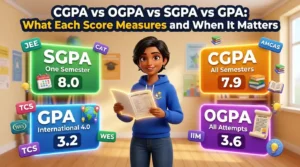
CGPA vs GPA vs SGPA — the key differences:
- GPA = grade point average for a single semester
- CGPA = cumulative average across all semesters
- SGPA (Semester Grade Point Average) = the Indian equivalent of GPA, calculated for one term on a 10-point scale
Quick worked example:
| Subject | Grade Point |
|---|---|
| Math | 8 |
| Physics | 7 |
| Chemistry | 9 |
| English | 8 |
CGPA = (8 + 7 + 9 + 8) ÷ 4 = 8.0
The credit system in Indian universities weights each subject differently — subjects with more credits carry more impact on the final CGPA. If your university uses credit-weighted grading, always factor in credit hours, not a plain subject average.
Before converting CGPA to percentage, it helps to know your SGPA values for each semester. Use the SGPA to CGPA converter to build up your cumulative figure from semester data.
CGPA to Percentage Formula (Standard 10-Point Scale)
The standard CGPA to percentage formula for a 10-point grading scale is Percentage = CGPA × 9.5. CBSE, Delhi University, and the majority of Indian universities use this as their official multiplying factor.
Formula 1 — Standard (CBSE, Delhi University, most Indian universities)
Percentage = CGPA × 9.5
| CGPA | Percentage |
|---|---|
| 10 | 95% |
| 9.5 | 90.25% |
| 9 | 85.5% |
| 8 | 76% |
| 7.5 | 71.25% |
| 7 | 66.5% |
| 6 | 57% |
| 5 | 47.5% |
Formula 2 — Alternative 10-point method
Percentage = (CGPA × 10) − 7.5
Some autonomous colleges and engineering institutions use this version when the ×9.5 rule does not apply. A CGPA of 8 gives 72.5% under this formula — 3.5 points lower than the standard result.
Is 7.5 CGPA equal to 75%?
No. On the standard ×9.5 formula used by CBSE and most Indian universities, 7.5 CGPA = 71.25%. It equals 75% only if your institution uses the ×10 formula, such as Anna University or KTU. Always check your university’s official grading policy before quoting a percentage figure.
The grading scale your university follows determines which formula applies. Using the wrong multiplier on a job application or scholarship form can misrepresent your academic standing. To skip manual calculation entirely, the CGPA calculator handles the conversion in seconds.
CGPA to Percentage for All Major Grading Scales
Different grading scales require different formulas — dividing by the maximum scale value and multiplying by 100 works universally when no official formula exists. The grade point average calculation changes depending on the system, so identifying your scale first is step one.
4.0 GPA Scale (USA, Canada, Australia, Pakistan HEC)
Percentage = (GPA ÷ 4.0) × 100
Example: 3.2 GPA → (3.2 ÷ 4) × 100 = 80%
The 4.0 scale is the most widely used grading system globally. Pakistan’s Higher Education Commission (HEC) uses the same structure — a 3.5 GPA converts to 87.5%.
5.0 CGPA Scale
Percentage = (CGPA ÷ 5.0) × 100
Example: 4.2 CGPA → (4.2 ÷ 5) × 100 = 84%
Some Asian universities and private institutions use the 5-point scale. The logic is identical to the 4.0 system — divide by the maximum, multiply by 100.
7.0 CGPA Scale (MAKAUT and select institutions)
Percentage = (CGPA ÷ 7.0) × 100
Example: 5.6 CGPA → (5.6 ÷ 7) × 100 = 80%
8.0 CGPA Scale
Percentage = (CGPA ÷ 8.0) × 100
Example: 6.4 CGPA → (6.4 ÷ 8) × 100 = 80%
Used by certain European and Asian universities.
20-Point Scale (France, Belgium)
Percentage = (Score ÷ 20) × 100
Example: 15 ÷ 20 × 100 = 75%
France and Belgium use a 20-point system. A score of 14/20 is considered strong — the equivalent of 70%, which many international institutions recognize as a merit-level result.
Universal Formula (When the official formula is unknown)
Percentage = (CGPA ÷ Maximum Scale) × 100
Example: CGPA of 3.5 on a 4.0 scale → (3.5 ÷ 4) × 100 = 87.5%
This formula acts as a safety net. When a university does not publish a specific multiplier, the universal method gives a defensible approximation.
Master conversion table — all scales at a glance:
| Scale | Formula | Example Input | Result |
|---|---|---|---|
| 10.0 | × 9.5 | 8.0 | 76% |
| 10.0 | (×10) − 7.5 | 8.0 | 72.5% |
| 4.0 | ÷ 4 × 100 | 3.2 | 80% |
| 5.0 | ÷ 5 × 100 | 4.0 | 80% |
| 7.0 | ÷ 7 × 100 | 5.6 | 80% |
| 8.0 | ÷ 8 × 100 | 6.4 | 80% |
| 20 | ÷ 20 × 100 | 15 | 75% |
The equivalent percentage your institution recognizes may differ from what this table shows for international scales. For quick conversions across all these systems, the main GPA to percentage calculator handles every scale in one place.
University-Specific CGPA to Percentage Formulas (India)
India’s major universities use institution-specific formulas that differ from the standard ×9.5 multiplier. Applying the wrong formula on an official document can misrepresent your academic record. The Council for Technical Education sets guidelines, but individual universities still define their own conversion rules.
| University | Formula | Example (CGPA 8) |
|---|---|---|
| CBSE / Delhi University | CGPA × 9.5 | 76% |
| Anna University / KTU | CGPA × 10 | 80% |
| VTU | (CGPA − 0.75) × 10 | 72.5% |
| Mumbai University (Engg) | 7.25 × CGPA + 11 | 69% |
| GTU | 7.1 × CGPA + 11 | 67.8% |
| Jain University | Institution-specific table | Check official |
The difference adds up fast. At a CGPA of 8, the gap between CBSE (76%) and GTU (67.8%) is over 8 percentage points — a gap that can affect scholarship eligibility or job cutoffs.
VTU subtracts 0.75 from the CGPA before multiplying by 10. Mumbai University adds a fixed offset of 11 to the product of a 7.25 multiplier. GTU uses 7.1 with the same offset structure. None of these follow the standard ×9.5 rule.
Always verify with your university’s official academic regulations before quoting a converted figure. For VTU students, the CGPA calculator includes the VTU-specific formula so the result matches official records.
When an institution requests formal proof of your converted percentage, a conversion certificate issued by the university carries more weight than a self-calculated figure. Most employers and universities abroad require the official document for verification.
CGPA to Percentage Calculator
The CGPA to percentage calculator converts your grade point average instantly across all major scales — enter your CGPA value and select your grading system to get the result with the formula shown.
- Input: CGPA value + scale selector (10, 4, 5, 7, 8, 20)
- Output: Percentage result + formula used
- Shows which universities use that formula
This tool supports the 10-point ×9.5 system, the 4.0 GPA scale, the 5.0 scale, and the universal normalization method in one interface. For the reverse calculation — finding CGPA from a known percentage — use the percentage to CGPA converter.
CGPA to Percentage Conversion Table (10-Point Scale, 6.0–10.0)
The table below covers the full common range on the 10-point scale using the standard ×9.5 formula. Students searching for specific values like “8 CGPA in percentage” or “9.5 CGPA percentage” can use this as a quick reference.
| CGPA | Percentage (×9.5) | Grade Band |
|---|---|---|
| 10.0 | 95% | Outstanding |
| 9.5 | 90.25% | Excellent |
| 9.0 | 85.5% | Excellent |
| 8.5 | 80.75% | Very Good |
| 8.0 | 76% | Very Good |
| 7.5 | 71.25% | Good |
| 7.0 | 66.5% | Good |
| 6.5 | 61.75% | Average |
| 6.0 | 57% | Average |
The percentage classification system — Distinction, First Class, Second Class — uses these percentage bands as cutoffs. A CGPA of 8.5 on the standard formula gives 80.75%, which typically falls within the First Class with Distinction bracket at most Indian universities.
For a complete breakdown of marks-based percentage calculations, the marks percentage calculator converts raw scores into percentage figures using your total marks and marks obtained.
How to Convert CGPA to Percentage: Step-by-Step
Converting CGPA to percentage takes four steps: identify your scale, confirm the official formula, apply it, and verify before submission.
Step 1: Identify the maximum scale your university uses Check your marksheet, academic transcript, or the university’s grading policy. The scale is typically 4.0, 5.0, or 10.0.
Step 2: Confirm the official multiplier Most Indian universities specify the conversion formula in their academic regulations. Look for it in the examination ordinance or the official gazette notification. Do not assume the ×9.5 rule applies — verify it.
Step 3: Apply the correct formula
- 10-point system (CBSE, DU) → CGPA × 9.5
- 10-point system (Anna University, KTU) → CGPA × 10
- 10-point system (VTU) → (CGPA − 0.75) × 10
- All other systems → (CGPA ÷ Max Scale) × 100
Step 4: Verify before submitting to official channels For job applications, scholarship portals, and university admissions, use the percentage shown on your official academic transcript — not a self-calculated figure. Many employers and institutions cross-check submitted percentages against official records.
Self-calculated conversions work for personal estimation. For anything official — visa applications, foreign university admissions, government job forms — the transcript or a university-issued conversion certificate takes precedence.
Percentage to CGPA: Reverse Conversion Formulas
Reverse conversion from percentage back to CGPA is possible by dividing by the same multiplier. The result is always an approximation because actual CGPA depends on individual subject grades, not a flat percentage figure.
- 10-point (×9.5 system): CGPA = Percentage ÷ 9.5
- 10-point (×10 system): CGPA = Percentage ÷ 10
- 4.0 scale: GPA = (Percentage ÷ 100) × 4.0
- 5.0 scale: GPA = (Percentage ÷ 100) × 5.0
- Universal: CGPA = (Percentage ÷ 100) × Maximum Scale
Example: 85% on a 10-point ×9.5 system → 85 ÷ 9.5 = 8.94 CGPA (approximate)
The approximation works in reverse the same way a recipe works backwards from the finished dish — you can estimate the ingredients, but small variations mean the exact result may differ. For a dedicated reverse tool, the percentage to CGPA calculator handles this directly.
CGPA vs GPA vs SGPA vs Percentage: What’s the Difference?
CGPA, GPA, SGPA, and percentage all measure academic performance — but they use different scopes, scales, and calculation methods. CGPA covers the full program; GPA covers one semester; SGPA is the Indian semester equivalent on a 10-point scale; percentage expresses marks out of 100. Confusing these four in an application is one of the most common student errors.
| Metric | Meaning | Scope | Common Scale |
|---|---|---|---|
| CGPA | Cumulative Grade Point Average | Entire program | 4.0 or 10.0 |
| GPA | Grade Point Average | One semester | 4.0 |
| SGPA | Semester Grade Point Average | One semester | 10.0 (India) |
| Percentage | Marks out of 100 | Subject or overall | 100 |
The semester performance index — sometimes used interchangeably with SGPA — measures the same data. Different institutions label it differently, but the underlying calculation is the same.
SGPA feeds directly into CGPA. Each semester’s SGPA, weighted by credit hours, combines to produce the cumulative figure. The SGPA to percentage calculator converts individual semester grades before you build up to the CGPA level — useful when working through semester-by-semester records.
CGPA for International Applications: What Universities Actually Need
International universities — particularly in the US, UK, and Germany — do not always accept self-converted percentages. Many require official credential evaluation from a recognized body.
US graduate schools: A minimum 3.0 GPA on the 4.0 scale is the standard requirement. Top programs at MIT and Stanford typically expect 3.5 or above. An Indian 7.5 CGPA on the 10-point scale approximates a 3.0 US GPA — using the formula (Indian CGPA ÷ 10) × 4.
UK universities: A CGPA between 5.0 and 6.0 on the 10-point scale is generally equivalent to a UK 2:1 (Upper Second Class). Most master’s programs set this as the minimum entry requirement.
Germany: Apply with your original grading scale. Do not self-convert to the German system unless specifically requested. German university portals use their own evaluation tools to assess foreign grades.
Official credential evaluation: World Education Services (WES) and NACES-member organizations provide standardized evaluations that universities formally accept. These carry more weight than any self-calculated figure. For admissions, scholarship portals, and visa applications, WES evaluation is the gold standard.
Self-conversion works for initial screening — figuring out whether you meet the threshold before applying. Once you’re in the application process, the official conversion certificate from your university or a WES report takes over.
Common Mistakes When Converting CGPA to Percentage
The most frequent conversion errors occur when students apply a formula from a different institution or confuse their grading scale. Getting this wrong on a job application or admission form creates problems that are harder to fix after submission.
- Using ×9.5 when your university uses ×10 — Anna University and KTU students make this error most often
- Applying the CBSE formula to a technical university — Mumbai University and GTU use offset-based formulas, not a simple multiplier
- Confusing GPA (semester) with CGPA (cumulative) in application fields that ask for overall academic standing
- Submitting a self-calculated percentage where an official conversion letter is required — some government job portals reject self-declared figures
- Treating percentage as a precise score when CGPA represents a grade band — an 8.0 CGPA might map to a range of 75-85%, not a fixed point
The attendance to percentage conversion is a separate calculation entirely — if you need to check attendance figures for eligibility criteria, the attendance to percentage calculator handles that independently from the CGPA conversion.
Frequently Asked Questions About CGPA to Percentage
Q1: How do you calculate CGPA to percentage?
Multiply your CGPA by 9.5 if you’re on the standard Indian 10-point scale. For other scales, divide your CGPA by the maximum scale value and multiply by 100. Always check your university’s official formula before quoting a figure.
Q2: Is 7.5 CGPA equal to 75%?
No. On the standard ×9.5 formula used by CBSE and most Indian universities, 7.5 CGPA = 71.25%. It equals 75% only if your institution uses the ×10 formula, such as Anna University or KTU.
Q3: What is 8 CGPA in percentage?
On the standard 10-point scale using ×9.5: 8 × 9.5 = 76%. On the ×10 formula used by Anna University: 8 × 10 = 80%. The answer depends entirely on which formula your university uses.
Q4: What is 87% in CGPA?
Using reverse conversion on the ×9.5 system: 87 ÷ 9.5 = approximately 9.16 CGPA. This figure is an estimate — actual CGPA depends on individual subject grades across all semesters.
Q5: What is a 2.62 CGPA in percentage?
On the 4.0 scale: (2.62 ÷ 4) × 100 = 65.5%. On the 10-point ×9.5 scale: 2.62 × 9.5 = 24.89% — which confirms why identifying your scale before converting is non-negotiable.
Q6: Is CGPA the same as GPA?
No. GPA measures performance for a single semester. CGPA is the cumulative average across all semesters of your program. They use the same scale — typically 4.0 — but measure different time spans.
Q7: Which formula does CBSE use for CGPA to percentage?
CBSE uses Percentage = CGPA × 9.5 as the official conversion formula for its 10-point grading system. This formula appears in CBSE’s official examination guidelines.
Key Takeaways: Converting CGPA to Percentage Accurately
CGPA to percentage conversion accuracy depends entirely on identifying the correct formula for your specific grading scale and institution. One formula does not fit all systems.
Core formula summary:
| System | Formula |
|---|---|
| 10-point (CBSE, DU) | CGPA × 9.5 |
| 10-point (Anna University, KTU) | CGPA × 10 |
| 10-point (VTU) | (CGPA − 0.75) × 10 |
| 4.0 scale | (GPA ÷ 4) × 100 |
| Universal fallback | (CGPA ÷ Max Scale) × 100 |
Use the CGPA calculator to convert instantly, or check the university-specific table above if you’re at VTU, GTU, Mumbai University, or Anna University. For semester-level data, the SGPA to CGPA tool builds your cumulative figure from individual semester scores. For international applications, always confirm which percentage figure your target university or employer requires — self-converted or officially issued.