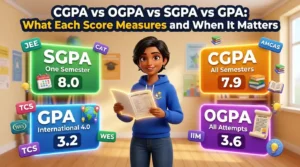


GPA (Grade Point Average) is a number between 0.0 and 4.0 that summarises a student’s academic performance in the United States. It converts letter grades (A, B, C, D, F) into numerical points, averages them across all courses, and produces a single score that colleges, employers, and scholarship programs use to evaluate academic standing. The average high school GPA in the US is approximately 3.0, and the average college GPA is approximately 3.1. For Indian students applying to US graduate programs, this system sits on a completely different scale from the 10-point CGPA used across Indian universities. Converting between the two correctly determines admission eligibility.
What Does GPA Mean and How Is It Different from CGPA?
GPA (Grade Point Average) in the US runs on a 0.0 to 4.0 scale. CGPA in India runs on a 0 to 10 scale. Both measure cumulative academic performance across all semesters, but they use different grade-to-point mappings, different credit systems, and different institutional grading cultures. A 3.2 GPA in the US does not represent the same marks as a 3.2 CGPA in India. They are measurements on two entirely separate scales.
The grade point average in the US assigns a fixed numerical value to each letter grade:
| Letter Grade | US GPA Points | Percentage Range (Approx.) |
|---|---|---|
| A+ | 4.0 | 97-100% |
| A | 4.0 | 94-96% |
| A- | 3.7 | 90-93% |
| B+ | 3.3 | 87-89% |
| B | 3.0 | 84-86% |
| B- | 2.7 | 80-83% |
| C+ | 2.3 | 77-79% |
| C | 2.0 | 74-76% |
| C- | 1.7 | 70-73% |
| D | 1.0 | 60-69% |
| F | 0.0 | Below 60% |
CGPA in India uses a 10-point scale where a grade of O (Outstanding) or A+ corresponds to 9.0-10.0 grade points. The same performance level produces a 9.5 on the Indian scale and approximately a 3.9 on the US scale, not a 9.5 out of 4.0.
How Is GPA Calculated in the US?
GPA in the US is calculated by multiplying each course’s grade points by its credit hours, summing all the products, then dividing by total credit hours. The formula is: GPA = Total (Grade Points x Credit Hours) / Total Credit Hours. This is a credit-weighted average, not a simple average of grades.
Worked example: A student takes five courses in a semester.
| Course | Credit Hours | Grade | Grade Points | Product |
|---|---|---|---|---|
| English | 3 | A- (3.7) | 3.7 | 11.1 |
| Algebra | 3 | B+ (3.3) | 3.3 | 9.9 |
| Spanish | 3 | A (4.0) | 4.0 | 12.0 |
| Chemistry | 4 | B (3.0) | 3.0 | 12.0 |
| Music | 1 | A (4.0) | 4.0 | 4.0 |
Total grade points product: 49.0. Total credit hours: 14. GPA = 49.0 / 14 = 3.5
The credit-hour weighting matters significantly. Chemistry (4 credits) affects this GPA four times more than Music (1 credit). A student who earns a B in a 4-credit core science course takes a larger GPA hit than a student who earns a B in a 1-credit elective. This mirrors exactly how CGPA works in Indian universities under the credit-based system.
What Is the Difference Between Weighted and Unweighted GPA?
Unweighted GPA caps at 4.0 and treats all courses equally regardless of difficulty. Weighted GPA allows scores above 4.0 by assigning extra points for Advanced Placement (AP), International Baccalaureate (IB), and honors courses, typically adding 0.5 points for honors and 1.0 point for AP or IB courses. Most US colleges convert submitted weighted GPAs back to unweighted during review.
Unweighted GPA example: A student earns an A in an AP Biology course. Under unweighted GPA, this earns 4.0 points, the same as an A in a regular Biology course.
Weighted GPA example: The same A in AP Biology earns 5.0 points under a weighted scale. This allows top students taking difficult coursework to exceed 4.0 and reach scores of 4.5 or 5.0.
When Indian students apply to US universities, their CGPA system does not distinguish between weighted and unweighted performance in the same way. WES (World Education Services) and similar credential evaluation bodies account for this difference by evaluating each course individually rather than applying a blanket formula. More on this in the conversion section below.
What Is Cumulative GPA vs Semester GPA?
Cumulative GPA averages your grade points across all semesters and all courses since the first day of high school or college. Semester GPA covers only the courses completed in one specific term. US colleges request cumulative GPA for admissions. Employers request cumulative college GPA when hiring. Semester GPA matters primarily for academic standing checks and scholarship renewals.
Cumulative GPA works the same way CGPA works in India. A strong Semester 5 raises it incrementally but does not erase a weak Semester 2. A weak semester lowers it proportionally based on how many credits it carries. National Center for Education Statistics (NCES) data shows the average high school cumulative GPA in the US runs at approximately 3.0, with highly selective university applicants typically presenting 3.7 and above.
The distinction between semester GPA and cumulative GPA catches many international students off guard. A US application form that asks for “GPA” almost always means cumulative GPA. Entering a single strong semester’s GPA instead of the cumulative figure misrepresents the academic record.
What Is a Good GPA in the US?
A good GPA in the US depends on the institution and the goal. A GPA of 3.5 to 4.0 is considered excellent for university admissions and scholarships. A GPA of 3.0 to 3.4 is considered good at most four-year universities. Ivy League universities (Harvard, Yale, Princeton, Columbia) do not publish minimum GPA requirements but admit students whose average GPA runs above 3.9.
Context changes what “good” means:
- For US college admissions: Top-50 universities expect a cumulative GPA of 3.5 or above for competitive consideration alongside test scores and extracurriculars.
- For US graduate school: Most programs require 3.0 minimum. Competitive engineering and business programs at top-20 universities typically see admitted students averaging 3.7 to 3.9.
- For scholarships: Merit-based aid programs commonly set 3.0 as the minimum. Many competitive scholarships require 3.5 or above.
- For NCAA athletic eligibility: The NCAA uses a sliding scale combining core course GPA and standardized test scores. Division I eligibility requires a 2.3 core GPA minimum.
- For employment: Most employers only request GPA for entry-level hiring, and many stop asking after candidates have 2-3 years of work experience.
Grade inflation exists in the US system. Studies show the average GPA at US universities rose from approximately 2.9 in the 1980s to approximately 3.1 in the 2020s. A 4.0 GPA from a US institution does not carry the same competitive rarity as a 9.8 CGPA from an Indian IIT, where strict grading culture produces a completely different distribution.
How Do Indian Students Convert CGPA to US GPA for Applications?
Indian students convert 10-point CGPA to US 4.0 GPA using the approximate formula: US GPA = (CGPA / 10) x 4. An 8.0 CGPA converts to approximately 3.2 GPA. However, this formula is a rough estimate. US graduate programs and credential evaluation services like WES (World Education Services) do not accept self-calculated conversions. They evaluate each course individually and account for the grading culture of the specific Indian university.
GPA to Percentage (gpatoopercentage.com) covers verified CGPA conversion formulas for 8 Indian universities: CBSE, VTU, Anna University, Mumbai University, SPPU, JNTUH, JNTUK, and GTU. Use the CGPA calculator to confirm your percentage equivalent before converting to the 4.0 GPA scale for any application.
Approximate CGPA to US GPA conversion table for Indian students:
| 10-Point CGPA | Approximate US GPA | WES Band |
|---|---|---|
| 9.0-10.0 | 3.7-4.0 | A / A+ |
| 8.0-8.99 | 3.3-3.7 | A- / B+ |
| 7.0-7.99 | 3.0-3.3 | B+ / B |
| 6.0-6.99 | 2.7-3.0 | B- / C+ |
| 5.0-5.99 | 2.0-2.7 | C |
| Below 5.0 | Below 2.0 | D / F |
Why WES evaluation matters more than the formula
WES analyzes each course individually, accounts for the grading strictness of your specific institution, and considers if your university is known for grade inflation. A 7.6 CGPA from IIT Madras receives a stronger WES evaluation than an 8.5 CGPA from a regional college with known grade inflation. WES maintains data on grading distributions across Indian institutions. A self-calculated 3.04 GPA and a WES-calculated 3.4 GPA from the same 7.6 CGPA are both possible depending on institutional context.
Most top US graduate programs (Stanford, MIT, Carnegie Mellon) state on their admissions pages that they evaluate international transcripts “in context” rather than through a direct formula. This means submitting your original transcript alongside your converted GPA, with the conversion source clearly noted.
Practical steps for Indian students
Step 1: Calculate your approximate US GPA using (CGPA/10) x 4 for initial self-assessment. Step 2: Order a WES Course-by-Course evaluation ($205 USD) at least 8-10 weeks before your first application deadline. Standard processing takes 7-10 business days after all documents are received. Step 3: Use the 4-point grading scale reference on gpatoopercentage.com to cross-check your converted figure against the standard 4.0 scale bands. Step 4: On applications that ask for both CGPA and GPA, enter your 10-point CGPA in the CGPA field and your WES-evaluated GPA in the GPA field. Never leave either field blank.
Frequently Asked Questions
What is a 4.0 GPA in America?
A 4.0 GPA in America means a student has earned an A in every graded course. Under the unweighted scale, 4.0 is the maximum achievable score. Under weighted scales, students taking AP or IB courses can exceed 4.0. The average GPA at US universities sits at approximately 3.1, making a 4.0 an above-average but not exceptional achievement at many institutions due to grade inflation.
Is a 75% a 2.0 GPA?
Under the standard US high school grading scale, 74-76% corresponds to a C grade, which equals 2.0 GPA. For Indian students using the direct percentage-to-GPA conversion, 75% divided by 25 gives 3.0, but this simple formula understates Indian academic performance. WES and Scholaro use a contextual scale where 60% from an Indian institution maps to approximately 3.0 GPA (B), since Indian grading standards are stricter than US grading standards.
What is a 3.5 GPA in America?
A 3.5 GPA in America corresponds approximately to a B+ average across all courses. It places a student in the 75th-85th percentile at most US universities. For graduate school applications, a 3.5 GPA is competitive at most top-50 programs and expected at many top-20 programs. For Indian students, a 3.5 US GPA roughly corresponds to an 8.7 CGPA on the 10-point scale using the (CGPA/10) x 4 formula.
How does GPA work in US colleges vs high schools?
US high school GPA and US college GPA operate on the same 4.0 scale with the same letter grade conversion. The key difference is that college courses carry more credits per course, making each grade’s impact on cumulative GPA more significant. Graduate school GPAs also use the 4.0 scale but often treat B or B- as the minimum acceptable grade, meaning anything below 3.0 in a graduate course is essentially failing by academic standing standards.
Do Indian students need to convert CGPA to GPA for every US application?
Not every US application requires a converted GPA. Many graduate programs ask for your original CGPA on the 10-point scale and perform their own evaluation. However, programs requiring WES evaluation, scholarship applications, and some employment verification processes require the 4.0 GPA figure. Always read the specific application instructions for each program. When both CGPA and GPA fields appear on the same form, enter your original 10-point CGPA in the CGPA field and your converted or WES-evaluated GPA in the GPA field.