
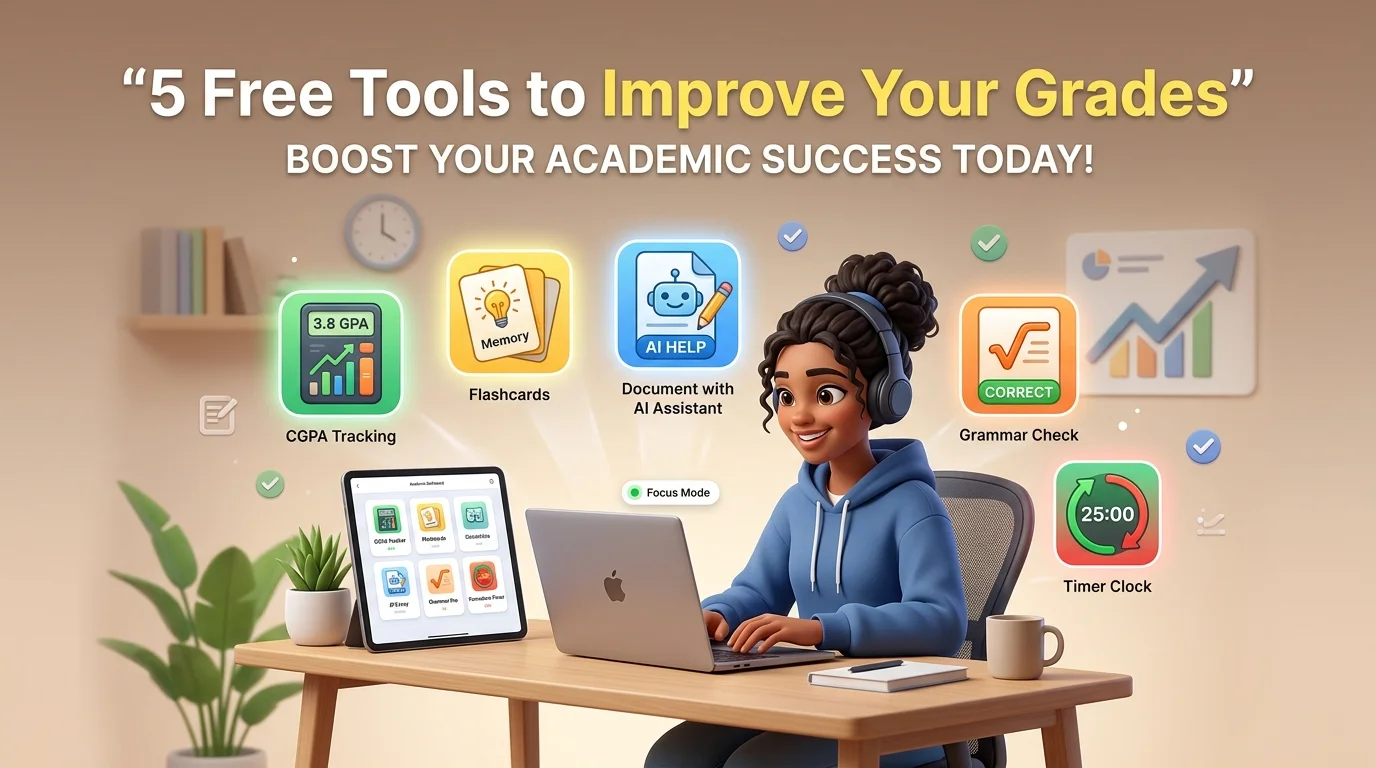
The right free study tools close the gap between hours spent studying and grades actually earned. gpatoopercentage.com, Anki, Google NotebookLM, Grammarly, and Pomofocus form a complete, zero-cost academic system used by 54,000+ students monthly across 47 countries. Students who track their CGPA weekly alongside structured study habits catch declining grades 6–8 weeks earlier than those who wait for semester results.
This guide covers what each tool does, what the free tier includes, and which students benefit most.
Why the Right Study Tools Change Your Academic Outcomes
The right study tool does not replace studying; it makes every study hour produce a measurable result.
Students using spaced repetition score 20–40% higher on recall tests than those using passive re-reading, according to educational psychology research on retrieval practice. That retention gap directly affects exam scores, which determines semester CGPA, which determines placement eligibility, where campus recruitment cutoffs at Indian universities range from 7.0 to 8.5 CGPA on a 10-point scale.
Most students study without measuring outcomes and discover the damage only at results, when recovery requires near-perfect scores across every remaining semester. The five free tools below eliminate that blind spot.
Tool #1: gpatoopercentage.com, Know Exactly Where Your Grades Stand
Studying harder only pays off if you can measure the result, and gpatoopercentage.com gives students 8 free grade-tracking tools to do exactly that.
Most students do not check their CGPA until official results are published. By then, recovery requires perfect scores across multiple remaining semesters. Checking takes 30 seconds.
gpatoopercentage.com calculates:
→ CGPA to Percentage, university-specific formulas for CBSE (x 9.5), VTU ((CGPA – 0.75) x 10), Anna University (x 10), and HEC Pakistan (x 25) → SGPA to CGPA, weighted semester-by-semester cumulative tracking → Marks Percentage, subject-wise score tracking from raw marks → Attendance Percentage, exam eligibility checker against your university’s 75% threshold → GPA Calculator, full support for 4.0, 5.0, and 10.0 grading scales
54,000+ students across 47 countries use these tools monthly. Calculation accuracy sits at 99.7%, built on verified formulas from 200+ institutions, not generic multipliers.
UGC mandates 75% minimum attendance for Indian university students. Missing that threshold blocks exam eligibility regardless of CGPA. Both checks take under 60 seconds combined.
→ Check your CGPA to percentage free, no account needed
Tool #2: Anki, The Free Flashcard App That Beats Cramming
Anki schedules flashcard reviews at the exact moment you are about to forget, not when you decide to study.
The app is built on the SuperMemo spaced repetition algorithm developed by Piotr Wozniak, which calculates the optimal review interval for each card based on how confidently you answered it. Memory decays predictably, reviewing just before that decay point builds long-term retention. Cramming does not.
- Free tier: 100% free on desktop (Windows, Mac, Linux) and AnkiWeb; AnkiDroid for Android is free; iOS app costs Rs 2,099 one-time
- Best for: Engineering, medical, and STEM students with high memorization loads, pharmacology, circuit theory, anatomy, and formula banks
- Scale: 50M+ users across 200+ countries, with shared decks covering UPSC, NEET, GATE, and university-specific syllabi
Students using Anki retain lecture content weeks after studying, not just the night before an exam.
Tool #3: Google NotebookLM, Turn Your PDFs Into a Study Assistant
Google NotebookLM turns uploaded documents into a private AI assistant that answers only from your material, eliminating the hallucination problem that makes general AI chatbots unreliable for exam preparation.
Upload PDFs, lecture slides, YouTube video links, or web pages. NotebookLM builds a knowledge base from those sources and returns answers with citations pointing to the exact page or timestamp. It does not pull from the internet, making it source-controlled and exam-accurate.
- Free tier: 100% free with any Google account, no credit card, no trial period
- Best for: Students managing dense reading loads in law, commerce, engineering, and medicine
- Key difference from ChatGPT: NotebookLM answers only from your uploaded content, no external data, no fabricated citations
Upload a 60-page textbook chapter and ask, “What are the 5 key concepts in Section 3?” NotebookLM returns a source-cited answer in under 30 seconds.
Tool #4: Grammarly, Write Assignments That Read Like You Mean It
Grammarly’s free tier catches the writing errors that cost students marks, grammar mistakes, unclear sentences, and tone mismatches between what they mean and what they write.
A 2,000-word assignment proofread manually takes 20–30 minutes. Grammarly reviews the same document in under 2 minutes, flagging errors, suggesting tighter phrasing, and detecting whether the tone reads as formal or casual.
Free tier covers:
- Grammar and spelling correction
- Clarity and conciseness suggestions
- Tone detection (formal vs. informal)
- Plagiarism detection, premium only
- Full AI rewriting, premium only
Best for: Commerce, MBA, law, arts, and social science students writing essays, research reports, and academic emails. Grammarly integrates with Chrome and Microsoft Word, no separate window required.
Tool #5: Pomofocus, The Free Timer That Ends Distracted Studying
Pomofocus implements the Pomodoro Technique, 25-minute focused study blocks followed by 5-minute breaks, in a free, browser-based timer that takes under 60 seconds to set up.
The Pomodoro Technique was developed by Francesco Cirillo in the late 1980s, named after a tomato-shaped kitchen timer he used as a university student. Fixed time blocks eliminate decision fatigue about how long to study, you press start and work until the timer ends.
- Free tier: 100% free, no account required, works on any browser at pomofocus.io
- Best for: Students who struggle with distraction or procrastination across any subject
- Output: 3 Pomodoros = 75 focused minutes with 2 short breaks, one complete study session for most topics
How These 5 Tools Work as One Study System
Each tool fills one specific academic gap. Combined, they cover every stage of a study session at zero cost.
| Academic Gap | Tool | Cost |
| Tracking grades and CGPA progress | gpatoopercentage.com | Free |
| Retaining content between sessions | Anki | Free |
| Understanding dense study material | Google NotebookLM | Free |
| Writing clear, accurate assignments | Grammarly | Free |
| Staying focused during study hours | Pomofocus | Free |
No single tool solves the whole problem. A student using only Anki builds retention but cannot measure whether that retention is translating into CGPA improvement. A student using only gpatoopercentage.com sees their grade trend but has no system to change it.
Together, these five free tools form a complete loop: track → retain → comprehend → write → focus → track again.
“This five-tool system costs Rs 0, requires no subscriptions, and covers the five variables that determine whether studying translates into better grades, tracking, memory, comprehension, writing, and focus.”
Build the System and Track the Results
These five free tools, gpatoopercentage.com, Anki, Google NotebookLM, Grammarly, and Pomofocus, cover every gap between studying and earning better grades.
The tools improve your academic performance. gpatoopercentage.com measures it, using the exact formula your university applies, not a generic multiplier.
→ Check Your CGPA Free, No Account Needed
Already tracking your CGPA? Use the SGPA to Percentage calculator to convert this semester’s grades before official results are published.
Frequently Asked Questions
Is Anki completely free?
Anki is 100% free on desktop and AnkiWeb. The iOS app costs Rs 2,099 as a one-time purchase. AnkiDroid for Android is free with no restrictions.
Does Google NotebookLM work with Indian university textbook PDFs?
Yes. NotebookLM processes any text-based PDF, including textbooks from VTU, Anna University, CBSE, and Delhi University, and returns source-cited answers directly from the uploaded document.
Does Grammarly’s free version help with academic writing?
Grammarly’s free tier corrects grammar, improves clarity, and detects academic tone, covering the core writing issues in most student assignments without a premium subscription.
How do I check if my CGPA meets placement eligibility?
Open the CGPA to Percentage Calculator on gpatoopercentage.com, select your university’s formula, VTU, CBSE, Anna University, or HEC Pakistan, enter your CGPA, and get your percentage in seconds.
How many classes can I miss before losing exam eligibility?
UGC and AICTE require 75% minimum attendance. The attendance percentage calculator on gpatoopercentage.com shows your current status and how many classes you can still miss.
Should a student start all 5 tools at once?
Start with gpatoopercentage.com to establish your grade baseline. Add Anki and Pomofocus in Week 1 for daily study. Add NotebookLM in Week 2 when you have material to upload. Use Grammarly only when writing assignments.